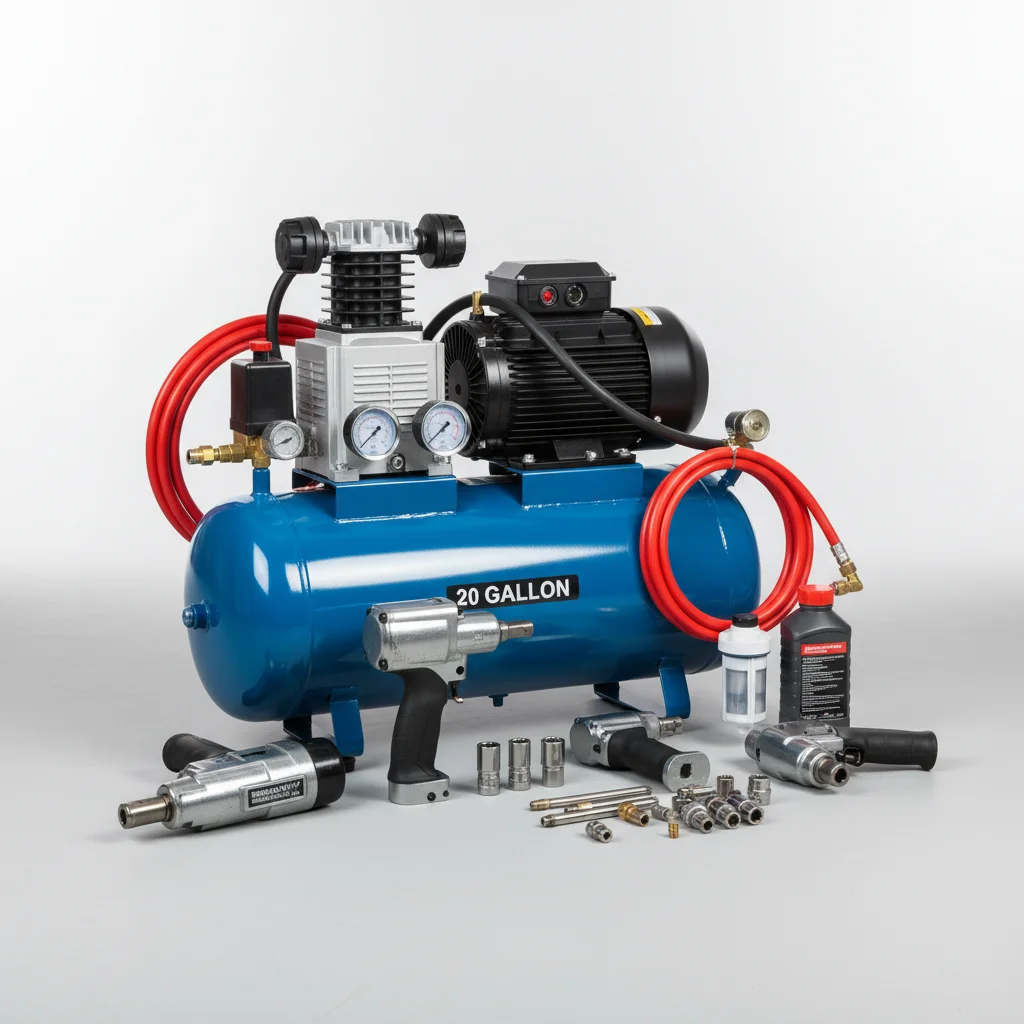
Choosing the right air compressor for your impact wrench is crucial for efficient work, and the ideal size largely depends on the wrench’s CFM (cubic feet per minute) requirements. For most automotive and DIY tasks, an air compressor delivering at least 4-5 CFM at 90 PSI is sufficient to power a standard 1/2-inch impact wrench. However, heavy-duty industrial impact wrenches may demand 10 CFM or more, necessitating a larger, more powerful compressor.
Understanding CFM and PSI for Impact Wrenches
Impact wrenches are air-hungry tools, and their performance is directly tied to the volume (CFM) and pressure (PSI) of air supplied by the compressor. CFM indicates how much air the compressor can deliver per minute, while PSI measures the force at which the air is delivered. Most impact wrenches specify their required CFM at a certain PSI, typically 90 PSI. Always check your impact wrench’s specifications to match it with a compressor that meets or exceeds these requirements. Insufficient CFM will lead to the wrench losing power quickly, while inadequate PSI will prevent it from reaching its full torque.
Tank Size vs. Continuous Airflow
While tank size is often the first thing people consider, it’s the compressor’s ability to produce continuous airflow (CFM) that truly matters for impact wrenches. A larger tank provides a buffer, allowing the compressor to run less frequently, but it won’t compensate for a low CFM output. For intermittent use, a 6-gallon pancake or hot dog style compressor might suffice. However, for sustained use, such as removing multiple lug nuts or working on a larger project, a compressor with a tank of 20 gallons or more, coupled with a high CFM rating, will provide a much better experience. Look for compressors with a higher SCFM (Standard Cubic Feet per Minute) rating, as this accounts for temperature and pressure variations.
Compressor Types for Impact Wrenches
|
Our Picks for the Best Air Compressor in 2026
As an Amazon Associate I earn from qualifying purchases.
|
||
| Num | Product | Action |
|---|---|---|
| 1 | DEWALT Tire Inflator Portable Air Compressor 20V MAX, Car Air Pump with Automatic Shut Off, LED Light, Tool Only (DCC020IB) |

|
| 2 | CRAFTSMAN Air Compressor, 2 Gallon Portable Air Compressor 1/3HP Max 125 PSI Oil-Free Light Weight with 10 PCS Accessory Kit |
|
| 3 | Tire Inflator Portable Air Compressor, 150PSI Cordless Air Pump for Car Tires with Auto Shut-Off, Portable Tire Pump for Car, Bike, Motorcycle and Balls |
|
| 4 | ECOMAX Air Compressor 6 Gallon 150 PSI Pancake Portable Oil-free Tank with 10 PCS Accessories Kit |
|
| 5 | Metabo HPT Pancake Air Compressor, 6-Gallon 165PSI, Portable Air Compressor with 1.0 HP Oil-Free High Efficiency Motor, Lihghtweight, Quick Couplers for Fast Tool Changes, EC711S |
|
| 6 | AC Compressor for 2000-2027 Chevy Silverado/GMC Sierra/Cadillac Escalade (4.8L/5.3L/6.0L V8) | OE Replaces 15036042, 15707611, CO29002C,78363, 78362 | A/C Compressor & Kit |
|
| 7 | Quiet Air Compressor, Only 68dB, 5 Gallon Steel Tank, 2.8CFM @ 90PSI, Oil-Free, Electric Air Compressor Perfect for Woodwork Nailing, Garage, Car, Pneumatic Tool, Includes 11 Accessories |
|
| 8 | California Air Tools CAT-4710W 1.0 HP Quiet and Oil-Free Air Compressor with Wheels, 4.7 Gallon Steel Tank, 75 dBA Noise Level, Lightweight |
|
| 9 | Airmoto Tire Inflator Portable Air Compressor - Air Pump for Car Tires with Digital Pressure Gauge, LED Light and Auto Shut-Off Function - Cordless Pump for Car, Motorcycle, Bicycle, Ball |
|
| 10 | Craftsman Air Compressors 6 Gallon Portable Pancake Air Compressor,Oil Free Max 150 Psi 1.0HP 2.6 CFM@90PSI Electric Air Compressor Shop Air Compressor, CMXECXA02106410 |
|
There are several types of air compressors suitable for impact wrenches, each with its own advantages. Portable electric compressors, often with smaller tanks, are great for occasional use and easy transport. Stationary electric compressors, typically with larger tanks and higher CFM, are ideal for workshops and garages where continuous power is needed. Gas-powered compressors offer maximum portability and are excellent for job sites without access to electricity, though they require more maintenance and ventilation. For heavy-duty applications, a two-stage compressor will provide higher pressure and more consistent airflow, making it suitable for industrial-grade impact wrenches.
- Single-stage compressors: Good for light to medium-duty impact wrenches.
- Two-stage compressors: Essential for heavy-duty and continuous impact wrench use.
- Oil-lubricated compressors: Generally more durable and quieter for prolonged use.
- Oil-free compressors: Require less maintenance but can be noisier.
- Portable compressors: Convenient for mobile tasks and smaller projects.
Matching Compressor to Wrench Application
The specific application of your impact wrench will dictate the compressor size. For light automotive work, like tire rotations or small engine repairs, a compressor with 4-6 CFM at 90 PSI and a 6-10 gallon tank will likely be adequate. For more demanding tasks, such as suspension work or removing rusted bolts, you’ll want a compressor that delivers 7-10 CFM at 90 PSI with a 20-30 gallon tank. Professional auto shops or industrial settings using high-torque impact wrenches will require a compressor capable of 10-15+ CFM at 90 PSI, often with a 60-gallon tank or larger, to ensure consistent power without frequent recovery cycles.
Essential Accessories and Maintenance
Beyond the compressor itself, several accessories are vital for optimal impact wrench performance. An air filter/regulator/lubricator (FRL) unit is highly recommended to ensure clean, dry, and lubricated air reaches your tool, extending its lifespan. High-quality air hoses with appropriate diameters (typically 3/8-inch for impact wrenches) are also crucial to prevent pressure drops. Regular maintenance, including draining moisture from the tank, checking oil levels (for oil-lubricated models), and cleaning air filters, will ensure your compressor continues to deliver reliable power to your impact wrench for years to come.
