Choosing the right air compressor is paramount for any successful sandblasting project, whether you are restoring a classic car, preparing surfaces for painting, or tackling industrial-scale cleaning. Without a consistent and powerful air supply, your sandblasting efforts will be inefficient, frustrating, and yield subpar results. Many professionals and serious DIY enthusiasts turn to two-stage air compressors, recognizing their superior capability to deliver the sustained performance required for abrasive blasting. This guide delves into why two-stage compressors are often the ideal choice for sandblasting, exploring their mechanics, key specifications, leading brands, and essential maintenance practices to help you make an informed decision and maximize your productivity.
Understanding Air Compressors for Sandblasting
At its core, an air compressor is a machine that converts power (from an electric motor or diesel engine) into potential energy stored in pressurized air. It draws in ambient air, compresses it, and then stores it in a receiver tank. This stored compressed air is then released on demand to power various pneumatic tools, including sandblasters.
Sandblasting, also known as abrasive blasting, is a demanding application that propels abrasive media at high speeds onto a surface to clean, etch, or prepare it. This process requires a continuous, high-volume flow of air at a consistent pressure to effectively remove material and achieve an even finish. If the air supply is insufficient, the abrasive stream weakens, leading to uneven patterns, slower work, and increased media consumption. This inherent need for sustained power is precisely why the choice of air compressor is so critical for any sandblasting operation.
Why Two-Stage Compressors are Ideal for Sandblasting
Two-stage air compressors, often called dual-stage or two-pump compressors, are a type of reciprocating piston compressor designed for more rigorous and continuous applications. Their fundamental advantage lies in how they achieve compression. Unlike single-stage compressors that compress air once to its final pressure, a two-stage compressor performs this process in two distinct steps. Air is initially compressed in a larger piston to an intermediate pressure, then cooled before being directed to a smaller, second piston for further compression to the desired higher pressure. This two-step process offers several significant benefits that make them particularly well-suited for sandblasting:
- Higher Pressures and Greater Air Reserve: Two-stage compressors can reach higher operating pressures, typically between 175-200 PSI, compared to the 130-150 PSI of most single-stage units. This means they can store more usable air at high pressure in the same size tank, providing a larger reserve for continuous blasting without constant cycling.
- Enhanced Efficiency: The intercooling between stages reduces the air temperature, making the second stage more efficient. This translates to more air output per horsepower, potentially allowing for a smaller compressor footprint to achieve the same CFM.
- Extended Durability and Cooler Operation: Compressing air in two stages distributes the workload, reducing stress on the internal components. The intercooling also means the compressor runs cooler, which significantly extends the pump’s lifespan and reduces wear and tear.
- Reduced Moisture Buildup: Lower operating temperatures help reduce the amount of moisture that forms during compression, contributing to drier air output, which is crucial for effective sandblasting and preventing clogs.
- Smoother, More Consistent Airflow: The design inherently provides a more stable and consistent flow of compressed air, which is vital for maintaining an even blast pattern and preventing pressure drops at the nozzle.
|
Our Picks for the Best Air Compressor in 2026
As an Amazon Associate I earn from qualifying purchases.
|
||
| Num | Product | Action |
|---|---|---|
| 1 | CRAFTSMAN Air Compressor, 2 Gallon Portable Air Compressor 1/3HP Max 125 PSI Oil-Free Light Weight with 10 PCS Accessory Kit |

|
| 2 | ECOMAX Air Compressor 6 Gallon 150 PSI Pancake Portable Oil-free Tank with 10 PCS Accessories Kit |
|
| 3 | AC Compressor for 2000-2027 Chevy Silverado/GMC Sierra/Cadillac Escalade (4.8L/5.3L/6.0L V8) | OE Replaces 15036042, 15707611, CO29002C,78363, 78362 | A/C Compressor & Kit |
|
| 4 | Craftsman Air Compressors 6 Gallon Portable Pancake Air Compressor,Oil Free Max 150 Psi 1.0HP 2.6 CFM@90PSI Electric Air Compressor Shop Air Compressor, CMXECXA02106410 |
|
| 5 | Metabo HPT Pancake Air Compressor, 6-Gallon 165PSI, Portable Air Compressor with 1.0 HP Oil-Free High Efficiency Motor, Lihghtweight, Quick Couplers for Fast Tool Changes, EC711S |
|
| 6 | Quiet Air Compressor, Only 68dB, 5 Gallon Steel Tank, 2.8CFM @ 90PSI, Oil-Free, Electric Air Compressor Perfect for Woodwork Nailing, Garage, Car, Pneumatic Tool, Includes 11 Accessories |
|
| 7 | Tire Inflator Portable Air Compressor, 150PSI Cordless Air Pump for Car Tires with Auto Shut-Off, Portable Tire Pump for Car, Bike, Motorcycle and Balls |
|
| 8 | DEWALT Tire Inflator Portable Air Compressor 20V MAX, Car Air Pump with Automatic Shut Off, LED Light, Tool Only (DCC020IB) |
|
| 9 | Airmoto Tire Inflator Portable Air Compressor - Air Pump for Car Tires with Digital Pressure Gauge, LED Light and Auto Shut-Off Function - Cordless Pump for Car, Motorcycle, Bicycle, Ball |
|
| 10 | California Air Tools CAT-4710W 1.0 HP Quiet and Oil-Free Air Compressor with Wheels, 4.7 Gallon Steel Tank, 75 dBA Noise Level, Lightweight |
|
These combined attributes make two-stage compressors the “sweet spot” for many sandblasting operations, offering a balanced combination of power, efficiency, and longevity that single-stage units simply cannot match for demanding, continuous tasks.
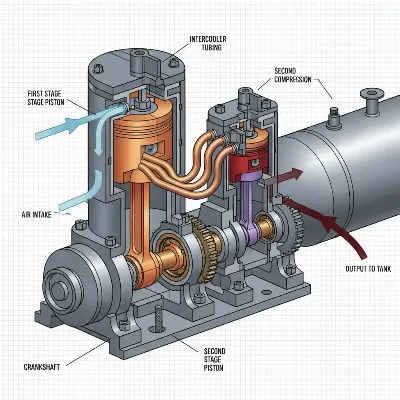 A detailed illustration of a two-stage air compressor pump, showing two different sized pistons, an intercooler, and the air compression process
Types of Air Compressors
While this guide focuses on two-stage piston compressors, it’s helpful to understand the broader landscape of air compressor types available and why some are more suitable for sandblasting than others. The primary categories include piston (reciprocating) and rotary screw compressors.
Two-Stage Piston Air Compressors
As discussed, two-stage piston compressors are a robust and popular choice, particularly for shops and professionals who require consistent, high-pressure air for tasks like sandblasting. Their key characteristics include:
- Advantages for Sandblasting:
- High Pressure Output: Capable of generating 175-200 PSI, providing ample pressure for most abrasive blasting needs.
- Increased Usable Air: Due to higher pressure, more air is stored in the tank, leading to longer continuous blasting times before the compressor cycles.
- Energy Efficiency: The two-stage process with intercooling reduces heat, making the compression more efficient compared to single-stage units of comparable horsepower.
- Extended Lifespan: Reduced stress on components and cooler operation translate to a longer service life and less frequent maintenance.
- Suitable for Intermittent to Continuous Use: While excellent for continuous operation, their larger tanks and higher pressures also make them ideal for intermittent heavy-duty tasks.
- Disadvantages:
- Higher Upfront Cost: Generally more expensive than single-stage piston compressors.
- Larger Footprint and Weight: Tend to be heavier and take up more space due to larger components and tanks.
- Noise Level: While often quieter than single-stage units for the same output, piston compressors can still be noisy and may require a dedicated compressor room.
Single-Stage Air Compressors (for contrast)
Single-stage piston compressors compress air in a single stroke of the piston. They are commonly found in home garages and smaller workshops due to their lower cost and simpler design.
- Limitations for Sandblasting:
- Lower Pressure Output: Typically max out around 130-150 PSI, which can be insufficient for consistent, powerful sandblasting, especially with larger nozzles or denser media.
- Lower CFM Output: For a given horsepower, single-stage compressors produce less CFM than two-stage units, meaning they struggle to keep up with the continuous air demands of sandblasting.
- Shorter Duty Cycle: They tend to run hotter and cycle more frequently under heavy loads, leading to faster wear and potential overheating. While suitable for light, intermittent tasks, they are generally not recommended for sustained sandblasting.
Rotary Screw Air Compressors (for heavy industrial applications)
Rotary screw compressors use two helical screws (rotors) to trap and compress air. They are the workhorses of industrial environments and are capable of continuous, 24/7 operation.
- Advantages for Sandblasting (especially large-scale):
- Continuous High CFM Output: Designed for non-stop, high-volume airflow, making them excellent for large industrial sandblasting operations.
- Superior Energy Efficiency: Often more energy-efficient than piston compressors for continuous, heavy loads, especially variable speed drive (VSD) models.
- Quiet Operation: Generally much quieter than piston compressors, contributing to a better working environment.
- Exceptional Durability and Longevity: Built for continuous duty, offering very long service lives with proper maintenance.
- Disadvantages:
- Highest Upfront Cost: Significantly more expensive than two-stage piston compressors.
- Maintenance Complexity: While durable, maintenance can be more specialized and costly.
- Overkill for Smaller Operations: For most hobbyists or small to medium shops, a rotary screw compressor is an unnecessary investment due to its high capacity and cost. They are best reserved for dedicated, high-demand industrial sandblasting systems.
Key Specifications for Sandblasting Air Compressors
Understanding the technical specifications of an air compressor is crucial for selecting a model that can effectively meet the demands of sandblasting. Focusing on these key metrics will help you avoid costly mistakes and ensure optimal performance.
Cubic Feet per Minute (CFM)
CFM, or Cubic Feet per Minute, measures the volume of air an compressor delivers. For sandblasting, CFM is arguably the most critical factor. Sandblasting nozzles consume a substantial amount of air, and a compressor with insufficient CFM will not be able to maintain the necessary pressure at the nozzle, leading to a weak, inconsistent blast stream.
- Importance for Continuous Blasting: Sandblasting is a continuous process. If your compressor’s CFM output is less than what your sandblaster and nozzle demand, the compressor will run constantly, struggling to keep up, leading to overheating and premature wear.
- CFM Requirements: These vary significantly based on your nozzle size, desired pressure, and the scale of your project:
- Small Projects (1/8″ nozzle): Typically require 18-35 CFM at 90 PSI.
- Medium Projects (3/16″ nozzle): Often need 70-90 CFM at 90-100 PSI.
- Heavy-Duty/Industrial (3/8″ or larger nozzle): Can demand 50-100 CFM, or even 100+ CFM for large blast pots or multiple guns. For example, a #5 nozzle blasting at 90 PSI can require 126 CFM.
- It is essential that your compressor’s CFM rating exceeds the CFM consumption of your sandblasting nozzle and any other air tools being used simultaneously.
Pounds per Square Inch (PSI)
PSI, or Pounds per Square Inch, measures the air pressure generated by the compressor. While CFM dictates the volume, PSI determines the force with which the abrasive media is propelled.
- Required Pressure Levels: Most sandblasters operate effectively within a range of 90-100 PSI, with a minimum of around 50 PSI required to start working. Lower PSI results in less aggressive blasting and slower material removal.
- Benefits of Higher PSI from Two-Stage Units: Two-stage compressors, capable of 175-200 PSI, provide a significant advantage. This higher tank pressure means there’s more potential energy stored, and it can be regulated down precisely to the desired working pressure (e.g., 90 PSI) with less strain on the compressor. This higher reserve pressure helps maintain consistent flow even as the tank drains, preventing pressure drops that can interrupt your work.
Tank Size
The air receiver tank stores compressed air, acting as a buffer between the compressor pump and the air tools. A larger tank provides a greater reserve of compressed air, allowing the compressor to cycle less frequently.
- Role in Air Reserve and Duty Cycle: For sandblasting, which demands continuous airflow, a larger tank is highly beneficial. It ensures that the compressor doesn’t have to run constantly to keep up with the demand, reducing wear and heat buildup.
- Recommended Capacities:
- For serious sandblasting, a minimum of a 60-gallon tank is often recommended.
- Many two-stage compressors suitable for sandblasting feature 80-gallon or even 120-gallon tanks. A 250-liter (approx. 66-gallon) tank or larger is suggested for compressors running five horsepower or more to ensure intermittent operation rather than continuous.
Horsepower (HP)
Horsepower (HP) is a measure of the motor’s power that drives the compressor pump. While not a direct measure of air output (CFM is), it correlates with the compressor’s overall capacity.
- Relationship to CFM: Higher HP motors typically drive larger, more capable pumps that produce higher CFM. For two-stage compressors used in sandblasting, a 5 HP motor is often considered a minimum for effective operation.
- Recommended HP Ranges:
- General Sandblasting: 5 HP or more.
- Moderate to Heavy Use: 7.5 HP to 10 HP.
- Industrial Applications: 15 HP, 20 HP, or even higher, particularly for large nozzles or multiple blasting stations.
Air Quality Management
Compressed air contains moisture, oil, and other contaminants that can severely impact sandblasting performance and equipment longevity.
- Importance of Air Dryers and Filters:
- Moisture Removal: Compressing air generates condensation. Moisture in the blast stream can clog nozzles, contaminate abrasive media, cause uneven blasting patterns, and lead to rust on the workpiece. Refrigerated air dryers or desiccant dryers are essential to remove this moisture.
- Oil Removal: Piston compressors, especially oil-lubricated ones, can introduce trace amounts of oil into the air. Oil in the blast stream can contaminate surfaces, preventing proper adhesion of paints or coatings. Oil-coalescing filters are used to remove these oil aerosols.
- Particulate Filters: Inline filters remove solid particles that could otherwise clog equipment or mar the blasted surface.
- Impact on Blasting Quality: Clean, dry, oil-free air ensures consistent media flow, prevents clogs, and delivers a superior, uncontaminated finish, which is critical for subsequent coating adhesion.
Comparison Table: Two-Stage Piston vs. Rotary Screw vs. Single-Stage
To further clarify why two-stage piston compressors often hit the sweet spot for sandblasting, let’s compare them against single-stage piston and rotary screw compressors across several key criteria.
| Feature | Single-Stage Piston | Two-Stage Piston | Rotary Screw |
|---|---|---|---|
| Initial Cost | Low | Medium to High | Very High |
| Pressure (PSI) | 130-150 PSI Max | 175-200 PSI Max | 100-200 PSI (Continuous) |
| CFM Output | Lower (for given HP) | Higher (for given HP) | Highest (for given HP), very stable |
| Duty Cycle | Intermittent (50-70%) | High (70-80% or near continuous) | Continuous (100%) |
| Noise Level | Moderate to High | Moderate (often quieter than single-stage for output) | Low to Moderate (much quieter than piston) |
| Efficiency | Lower for demanding tasks | Good, especially for high-pressure needs | Excellent, especially for continuous operation |
| Durability | Good for light use, wears faster under heavy load | Very Good, longer pump life | Excellent, built for continuous industrial use |
| Maintenance | Basic (oil, filter, drain) | Standard (oil, filter, drain) | More specialized and potentially costly |
| Best Use Case for Sandblasting | Very Small/Hobby, Occasional Use | Small to Medium Shops, Professional Applications, Heavy-Duty DIY | Large Industrial Facilities, Continuous Production Blasting |
> “For anyone serious about sandblasting, a two-stage compressor isn’t just an upgrade; it’s a necessity. It ensures you have the consistent airflow and pressure to tackle tough jobs efficiently, rather than constantly waiting for your compressor to catch up.” – Eky Barradas, Industrial Tools Expert & DIY Enthusiast [cite: 2.1]
Choosing the Right Two-Stage Air Compressor for Your Sandblasting Needs (Buying Guide)
Selecting the best two-stage air compressor for sandblasting involves careful consideration of your specific requirements and budget.
Assess Your Sandblasting Projects
Start by clearly defining the scope of your typical projects:
- Project Scale: Are you working on small automotive parts, medium-sized furniture, or large industrial equipment/structures?
- Nozzle Size: What size blasting nozzle(s) do you plan to use? This is the primary driver for CFM requirements. A 1/8″ nozzle for fine work is very different from a 3/8″ nozzle for heavy stripping.
- Abrasive Media: Denser or coarser media (e.g., steel grit, aluminum oxide) typically require higher CFM and PSI to propel effectively than lighter media (e.g., glass beads, plastic media).
- Frequency of Use: Will you be sandblasting occasionally, several times a week, or as a continuous daily operation? This influences the required duty cycle and overall durability.
Calculate CFM and PSI Requirements
Once you’ve assessed your project scope, quantify your air needs:
- Nozzle CFM Demand: Identify the CFM consumption of your desired nozzle at your target blasting pressure (e.g., 90-100 PSI). Consult CFM charts provided by nozzle manufacturers or general sandblasting resources. Remember, a worn nozzle will demand more CFM than a new one.
- Buffer for Losses: Factor in potential pressure drops through hoses, fittings, and air treatment accessories (filters, dryers). It’s wise to add a safety margin (e.g., 20-30%) to your calculated CFM requirement.
- Multiple Tools: If you plan to run other air tools simultaneously, add their CFM requirements to your total.
- Future Growth: Consider if your blasting needs might increase in the future. Investing in a slightly larger compressor than your immediate needs might save you from an upgrade down the line.
Consider Tank Size and Duty Cycle
- Tank Volume: Aim for at least a 60-gallon tank for serious sandblasting. 80-gallon or 120-gallon tanks are often ideal for continuous, demanding work as they provide a significant air reserve, reducing compressor cycling and extending component life.
- Duty Cycle: For sandblasting, you need a compressor that can handle a high duty cycle, ideally 70-80% or designed for continuous operation. Two-stage compressors are inherently better equipped for this than single-stage units.
Budget and Investment
Two-stage air compressors represent a more significant investment than single-stage models.
- Upfront Cost vs. Long-Term Value: While the initial cost is higher, remember that two-stage compressors offer superior efficiency, durability, and performance for sandblasting. This often translates to lower operating costs (energy savings) and reduced maintenance/replacement expenses over their lifespan.
- Power Requirements: Consider the electrical requirements. Many powerful two-stage compressors need a 240V circuit, which might require an electrical upgrade in some workshops or garages.
Brand Reputation and Support
Investing in a reputable brand can provide peace of mind regarding quality, reliability, and after-sales support.
- Established Manufacturers: Look for brands with a long history of producing quality air compressors for industrial and professional use.
- Warranty and Service: A good warranty and accessible parts and service network are crucial for any long-term equipment investment.
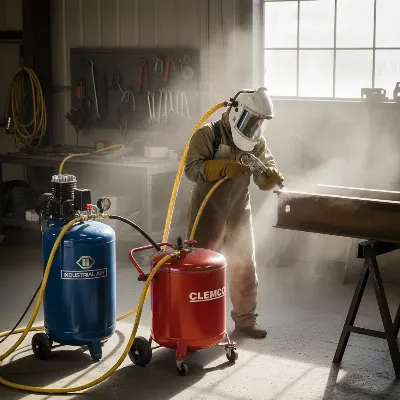 A detailed photograph of a professional sandblasting setup with a two-stage air compressor, a blast pot, and a worker in full PPE.
Leading Brands in Two-Stage Air Compressors for Sandblasting
The market offers several highly reputable manufacturers producing two-stage air compressors well-suited for sandblasting. Here are some of the prominent names:
- Ingersoll Rand: Consistently ranked among the top. Ingersoll Rand is known for its robust, industrial-grade two-stage reciprocating compressors that offer exceptional durability and continuous-duty performance. Models like their 5HP or 7.5HP two-stage units with 80-gallon tanks are frequently recommended for continuous painting, sandblasting, and heavy multi-tool use in shops. They are built with quality cast iron and designed for extended pump life.
- Quincy Compressor: A premium industrial brand renowned for its long-lasting and heavy-duty compressors. Quincy’s two-stage models, while often more expensive, boast impressive pump life (e.g., 30,000 hours) and are a worthwhile investment for professionals requiring maximum reliability and sustained performance.
- Campbell Hausfeld: Offers reliable two-stage options that can be more budget-friendly while still delivering solid performance for serious DIYers and smaller shops. Their units often feature dual-voltage motors, making them versatile for different electrical setups.
- DeWalt: Known for durable tools, DeWalt also produces high-performance two-stage air compressors that offer significant CFM at high PSI, making them a strong premium option for professionals.
- HPDMC: Specializes in heavy-duty, high-CFM two-stage compressors, often suitable for demanding industrial applications where continuous, high-volume air is paramount.
- Atlas Copco, Kaeser Kompressoren, Sullair, Gardner Denver: These are major industrial players, primarily known for their high-capacity rotary screw compressors, but also offer robust piston options suitable for industrial settings. Kaishan, for instance, specializes in energy-efficient two-stage rotary screw compressors.
When considering a brand, look for specific models that align with your CFM, PSI, and tank size requirements, and always prioritize those with strong reviews for reliability and customer service.
Essential Tips for Using and Maintaining Your Two-Stage Air Compressor
Proper usage and regular maintenance are crucial for maximizing the lifespan and performance of your two-stage air compressor, especially when used for demanding tasks like sandblasting.
Safety Precautions During Operation
Safety should always be your top priority when operating any pneumatic equipment, especially sandblasters.
- Personal Protective Equipment (PPE): Always wear appropriate PPE, including a NIOSH-approved respirator or blast helmet with an air supply, heavy-duty gloves, eye protection, ear protection, and protective clothing to guard against abrasive rebound.
- Ventilation: Ensure adequate ventilation when sandblasting, as the process creates significant dust.
- Read Manuals: Always read and understand the operating and safety manuals for both your air compressor and your sandblasting equipment.
- Stable Placement: Position your compressor on a flat, stable surface.
- Proper Connections: Ensure all hoses, fittings, and connections are securely fastened and rated for the pressure you are using. Avoid kinks or damaged hoses.
Regular Maintenance Tasks
Consistent maintenance prevents breakdowns and ensures your compressor runs efficiently.
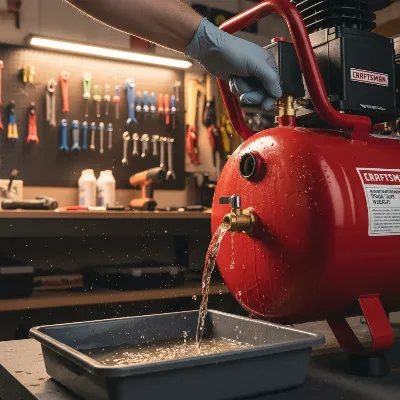
- Drain the Air Tank Regularly: Moisture accumulates in the tank due to condensation. Drain the tank daily or after each use to prevent rust inside the tank, which can weaken the metal and contaminate your air supply.
- Check and Change Oil (for oil-lubricated models): Follow the manufacturer’s recommendations for oil type and change intervals. Dirty or low oil levels can lead to overheating and severe pump damage.
- Inspect and Clean Air Filters: The intake air filter prevents dust and debris from entering the pump. Check it regularly (e.g., weekly) and clean or replace it as needed to ensure proper airflow and prevent pump strain.
- Check Belts (for belt-driven models): Inspect drive belts for wear, cracking, or proper tension. Loose belts reduce efficiency, while worn belts can break.
- Inspect Hoses and Fittings: Look for leaks, cracks, or damage in air hoses, couplings, and regulators. Leaks waste air and reduce efficiency.
- Monitor Pressure Gauges: Regularly check your compressor’s pressure gauges to ensure they are functioning correctly and that the compressor is building and maintaining pressure as expected.
- Clean Cooling Fins: Keep the pump’s cooling fins clean and free of dust or debris to ensure efficient heat dissipation.
Optimizing Air Lines and Accessories
- Hose Sizing: Use air hoses with a sufficiently large internal diameter (ID) to minimize pressure drop. For CFM requirements of 70-90 CFM and above, use 1/2″ ID hoses or larger where possible. Keep hose runs as short and straight as possible.
- Full-Flow Couplers: Invest in full-flow air couplers and fittings that match your hose ID to avoid restricting airflow. Undersized quick-connects can significantly choke the air supply.
- Quality Nozzles: Use high-quality, long-wearing nozzles, such as those made from tungsten carbide or boron carbide, especially for demanding sandblasting. Worn nozzles can increase CFM requirements by over 50 CFM for even a 1/16″ increase in orifice size.
- Air Treatment: Always use appropriate air dryers and coalescing filters to ensure clean, dry, oil-free air for optimal blasting results and to protect your equipment.
Conclusion
For anyone serious about achieving professional-grade results in sandblasting, a two-stage air compressor stands out as the superior choice. Its ability to deliver higher pressures and a more consistent, high-volume airflow ensures efficient abrasive projection, preventing the frustrating pressure drops and inconsistent finishes associated with less capable machines. By understanding the critical factors of CFM, PSI, tank size, and horsepower, and by investing in a reputable brand, you can select a compressor that perfectly matches your project needs. Remember, consistent maintenance and adherence to safety protocols will not only extend the life of your valuable equipment but also guarantee a safer and more productive blasting experience. Are you ready to elevate your sandblasting projects with the power and reliability of a two-stage air compressor?
Frequently Asked Questions
How often should I drain my air compressor tank?
You should drain your Air Compressor tank daily or after every use, especially in humid environments. Condensation naturally forms inside the tank as air is compressed, and regular draining prevents rust buildup, which can compromise the tank’s integrity and contaminate your air supply.
What’s the difference between CFM and SCFM?
CFM (