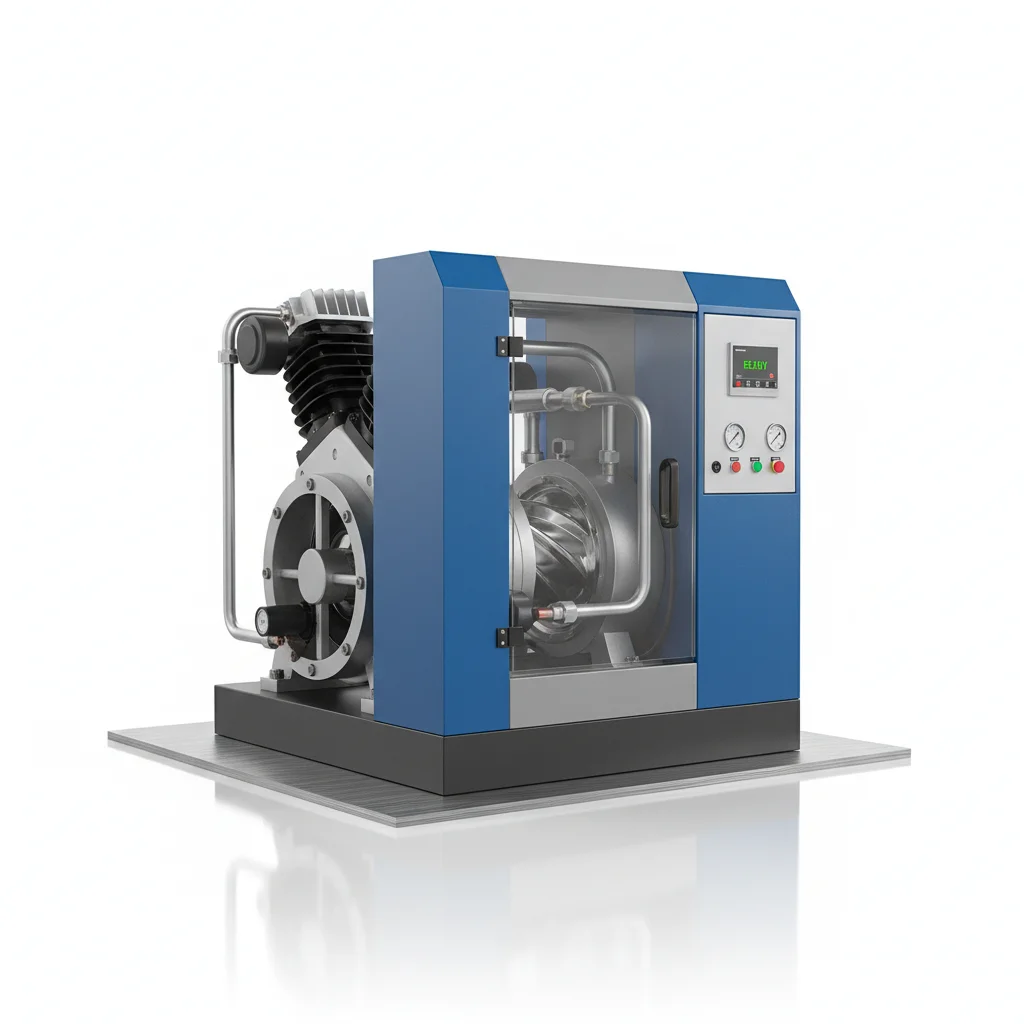
Rotary screw air compressors are a significant investment, and determining if they are the right choice for your business depends on several key factors, primarily your continuous air demand, operational hours, and budget. For businesses requiring a consistent, high volume of compressed air for extended periods, such as manufacturing plants or large automotive shops, a rotary screw compressor is often the most efficient and cost-effective solution. They are designed for continuous duty cycles, offering superior energy efficiency and a longer lifespan compared to piston-driven compressors in such demanding environments.
Understanding Rotary Screw Technology
Rotary screw compressors operate by trapping air between two meshing helical rotors, reducing the volume as the rotors turn, and thus compressing the air. This continuous compression process results in a smooth, pulsation-free airflow, which is ideal for sensitive equipment and processes. Unlike reciprocating compressors that use pistons and valves, rotary screws have fewer moving parts, leading to less vibration, quieter operation, and reduced wear and tear. This design inherently contributes to their reliability and suitability for industrial applications where uptime is critical.
Key Benefits for Industrial Applications
The advantages of rotary screw compressors in industrial settings are numerous. Their continuous duty cycle capability means they can run 24/7 without overheating or significant performance degradation, a critical factor for production lines. They are also significantly more energy-efficient for high-demand applications, often leading to substantial savings on electricity bills over time. Furthermore, the consistent air pressure and flow they provide are essential for tools and machinery that require a stable air supply, preventing fluctuations that can impact product quality or operational efficiency. Many models also offer variable speed drive (VSD) technology, which further optimizes energy consumption by matching the compressor’s output to the exact air demand.
- Continuous, reliable air supply for demanding operations.
- Superior energy efficiency for high-volume usage.
- Quieter operation compared to reciprocating compressors.
- Longer service life with fewer moving parts.
- Consistent air pressure and flow for sensitive equipment.
Considerations Before Investing
|
Our Picks for the Best Air Compressor in 2026
As an Amazon Associate I earn from qualifying purchases.
|
||
| Num | Product | Action |
|---|---|---|
| 1 | California Air Tools CAT-4710W 1.0 HP Quiet and Oil-Free Air Compressor with Wheels, 4.7 Gallon Steel Tank, 75 dBA Noise Level, Lightweight |

|
| 2 | Metabo HPT Pancake Air Compressor, 6-Gallon 165PSI, Portable Air Compressor with 1.0 HP Oil-Free High Efficiency Motor, Lihghtweight, Quick Couplers for Fast Tool Changes, EC711S |
|
| 3 | Tire Inflator Portable Air Compressor, 150PSI Cordless Air Pump for Car Tires with Auto Shut-Off, Portable Tire Pump for Car, Bike, Motorcycle and Balls |
|
| 4 | DEWALT Tire Inflator Portable Air Compressor 20V MAX, Car Air Pump with Automatic Shut Off, LED Light, Tool Only (DCC020IB) |
|
| 5 | ECOMAX Air Compressor 6 Gallon 150 PSI Pancake Portable Oil-free Tank with 10 PCS Accessories Kit |
|
| 6 | Craftsman Air Compressors 6 Gallon Portable Pancake Air Compressor,Oil Free Max 150 Psi 1.0HP 2.6 CFM@90PSI Electric Air Compressor Shop Air Compressor, CMXECXA02106410 |
|
| 7 | Airmoto Tire Inflator Portable Air Compressor - Air Pump for Car Tires with Digital Pressure Gauge, LED Light and Auto Shut-Off Function - Cordless Pump for Car, Motorcycle, Bicycle, Ball |
|
| 8 | Quiet Air Compressor, Only 68dB, 5 Gallon Steel Tank, 2.8CFM @ 90PSI, Oil-Free, Electric Air Compressor Perfect for Woodwork Nailing, Garage, Car, Pneumatic Tool, Includes 11 Accessories |
|
| 9 | CRAFTSMAN Air Compressor, 2 Gallon Portable Air Compressor 1/3HP Max 125 PSI Oil-Free Light Weight with 10 PCS Accessory Kit |
|
| 10 | AC Compressor for 2000-2027 Chevy Silverado/GMC Sierra/Cadillac Escalade (4.8L/5.3L/6.0L V8) | OE Replaces 15036042, 15707611, CO29002C,78363, 78362 | A/C Compressor & Kit |
|
While the benefits are compelling, there are important considerations before purchasing a rotary screw air compressor. The initial capital cost is typically higher than that of a comparable reciprocating compressor. However, this higher upfront cost is often offset by lower operating costs and longer lifespan in appropriate applications. Maintenance, while less frequent, can be more specialized, requiring trained technicians for certain tasks. It’s crucial to accurately assess your current and future air demand to ensure you select a unit with the correct CFM and PSI ratings. Oversizing can lead to inefficiencies, while undersizing can strain the unit and reduce its lifespan. Consulting with an air compressor specialist can help in this critical sizing process.
Installation and Maintenance Requirements
Proper installation is paramount for the optimal performance and longevity of a rotary screw compressor. This includes ensuring adequate ventilation, a stable foundation, and correct electrical hookups. Regular maintenance, though less frequent than with other types, is still essential. This typically involves oil changes, filter replacements (air, oil, and separator), and checking for leaks or unusual noises. Adhering to the manufacturer’s recommended service schedule will maximize the compressor’s lifespan and maintain its efficiency. Many modern rotary screw compressors come with advanced diagnostic systems that alert users to potential issues, simplifying preventative maintenance.
When to Choose a Rotary Screw Compressor
A rotary screw air compressor is the ideal choice if your business operates with a continuous demand for compressed air, typically exceeding 15-20 CFM, for more than 4-6 hours per day. Industries such as automotive manufacturing, food and beverage production, pharmaceuticals, and large-scale woodworking shops are prime candidates. If your operations involve critical processes where even minor fluctuations in air pressure can cause significant problems, the stable output of a rotary screw unit is invaluable. For intermittent use or smaller workshops with lower air demands, a reciprocating compressor might still be a more cost-effective initial investment. However, for long-term, heavy-duty applications, the efficiency and reliability of a rotary screw compressor make it a superior choice.
