Imagine the frustration of a flat tire just when you’re rushing out, or the endless manual effort of driving nails for a weekend project. For many homeowners and DIY enthusiasts, a capable air compressor is no longer a luxury but a fundamental tool. Among the myriad options available, the Craftsman 6-gallon portable pancake air compressor has emerged as a popular choice, promising robust performance in a compact, user-friendly package. This review delves into its capabilities, design, and practical applications, helping you decide if this red workhorse is the right fit for your workshop.
Overview of Air Compressors
At its core, an air compressor is a machine that converts power into potential energy stored in pressurized air. By drawing in ambient air and compressing it into a storage tank, it creates a readily available power source for various pneumatic tools. This simple yet effective principle has made air compressors indispensable across countless applications, from inflating tires and powering nail guns in residential settings to driving heavy machinery and tools in large-scale industrial operations. The versatility of compressed air makes these machines invaluable for efficiency and convenience.
Understanding Air Compressor Types
Air compressors come in various forms, each designed for specific performance needs and applications. While the Craftsman 6-gallon model falls into the piston category, understanding the broader landscape helps contextualize its place in the market.
Piston Air Compressors
Piston compressors, also known as reciprocating compressors, are the most common type for residential and light commercial use. They operate by using pistons driven by a crankshaft to compress air within a cylinder.
- Advantages: They are generally more affordable, versatile for intermittent use, and easier to maintain for basic models. Many portable compressors, like the pancake style, fall into this category.
- Disadvantages: They can be noisy and typically generate heat, requiring cooling. For continuous, heavy-duty operation, their efficiency can be lower than other types.
- Suitable Applications: Ideal for tasks such as inflating, fastening with nail guns, paint spraying, and basic automotive work.
|
Our Picks for the Best Air Compressor in 2026
As an Amazon Associate I earn from qualifying purchases.
|
||
| Num | Product | Action |
|---|---|---|
| 1 | Metabo HPT Pancake Air Compressor, 6-Gallon 165PSI, Portable Air Compressor with 1.0 HP Oil-Free High Efficiency Motor, Lihghtweight, Quick Couplers for Fast Tool Changes, EC711S |

|
| 2 | Quiet Air Compressor, Only 68dB, 5 Gallon Steel Tank, 2.8CFM @ 90PSI, Oil-Free, Electric Air Compressor Perfect for Woodwork Nailing, Garage, Car, Pneumatic Tool, Includes 11 Accessories |
|
| 3 | California Air Tools CAT-4710W 1.0 HP Quiet and Oil-Free Air Compressor with Wheels, 4.7 Gallon Steel Tank, 75 dBA Noise Level, Lightweight |
|
| 4 | DEWALT Tire Inflator Portable Air Compressor 20V MAX, Car Air Pump with Automatic Shut Off, LED Light, Tool Only (DCC020IB) |
|
| 5 | Craftsman Air Compressors 6 Gallon Portable Pancake Air Compressor,Oil Free Max 150 Psi 1.0HP 2.6 CFM@90PSI Electric Air Compressor Shop Air Compressor, CMXECXA02106410 |
|
| 6 | AC Compressor for 2000-2027 Chevy Silverado/GMC Sierra/Cadillac Escalade (4.8L/5.3L/6.0L V8) | OE Replaces 15036042, 15707611, CO29002C,78363, 78362 | A/C Compressor & Kit |
|
| 7 | Tire Inflator Portable Air Compressor, 150PSI Cordless Air Pump for Car Tires with Auto Shut-Off, Portable Tire Pump for Car, Bike, Motorcycle and Balls |
|
| 8 | Airmoto Tire Inflator Portable Air Compressor - Air Pump for Car Tires with Digital Pressure Gauge, LED Light and Auto Shut-Off Function - Cordless Pump for Car, Motorcycle, Bicycle, Ball |
|
| 9 | CRAFTSMAN Air Compressor, 2 Gallon Portable Air Compressor 1/3HP Max 125 PSI Oil-Free Light Weight with 10 PCS Accessory Kit |
|
| 10 | ECOMAX Air Compressor 6 Gallon 150 PSI Pancake Portable Oil-free Tank with 10 PCS Accessories Kit |
|
Rotary Screw Air Compressors
Rotary screw compressors use two intermeshing helical screws to compress air. This design allows for continuous airflow and is common in industrial settings.
- Advantages: Known for continuous operation, higher efficiency, quieter performance, and longer lifespan compared to piston compressors for heavy use. They also produce less heat and deliver a consistent airflow.
- Disadvantages: Significantly more expensive upfront and typically require professional maintenance. They are also much larger and less portable.
- Suitable Applications: Manufacturing plants, automotive assembly lines, large workshops, and any application requiring constant, high-volume air.
Centrifugal Air Compressors
Centrifugal compressors are dynamic machines that use an impeller to accelerate air, then decelerate it in a diffuser to increase pressure. These are typically very large, high-capacity units.
- Advantages: Deliver extremely high volumes of air, excellent for very large industrial applications, highly efficient for their scale, and produce oil-free air (important for certain industries).
- Disadvantages: Very high initial cost, complex systems requiring specialized installation and maintenance, and less efficient for lower flow rates or variable demand.
- Suitable Applications: Large-scale industrial processes, power generation, wastewater treatment, and chemical plants where massive airflow is needed.
Craftsman 6 Gallon Pancake Compressor: In-Depth Review
The Craftsman 6-gallon pancake air compressor (model CMEC6150K) positions itself as a robust solution for a wide array of home and light professional tasks, blending power with impressive portability.
Performance and Specifications
At the heart of this compressor’s appeal are its core performance metrics. It boasts a maximum operating pressure of 150 PSI, providing ample power for most common home garage and DIY applications. The compressor also delivers 2.6 SCFM (Standard Cubic Feet per Minute) at 90 PSI, which is a crucial indicator of its ability to maintain airflow to tools. This respectable SCFM rating ensures a quick recovery time, meaning less waiting for the tank to refill in the middle of a job, keeping your workflow smooth and efficient. The 6-gallon tank strikes a balance, offering sufficient stored air for a variety of tasks without becoming overly bulky. Furthermore, its high-performance motor is designed for easy startup, even in cold weather and low-voltage situations, preventing common frustrations when temperatures drop. [cite: 3 (search)]
Design and Portability
One of the most defining characteristics of this Craftsman unit is its “pancake” design. This unique configuration isn’t just aesthetic; it’s highly functional, providing a flat, stable base that makes the compressor less prone to tipping over during use or transport. [cite: 1, 5 (search)] Weighing in at approximately 30.8 to 32.5 pounds and featuring compact dimensions (around 16.5 inches in length and width, and 17.88 inches tall), the unit is remarkably lightweight and portable. [cite: 1, 4 (search)] An integrated carry handle further enhances its ease of movement, making it simple to transport from the workshop to the job site. The inclusion of rubberized feet is a thoughtful touch, reducing vibration and protecting both the compressor’s legs and the surfaces it sits on. [cite: 2, 3 (search)] While its lightweight nature makes up for it in most scenarios, it’s worth noting that it does not come with wheels, which could be a minor inconvenience for frequently moving it across longer distances.
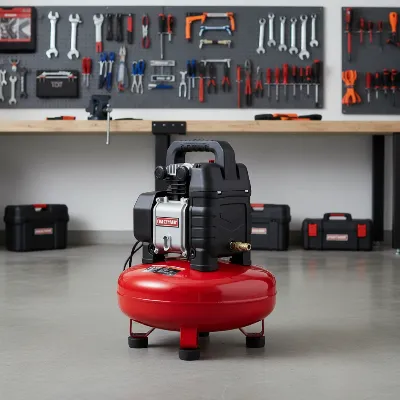 A Craftsman 6-gallon pancake air compressor with its integrated handle and stable design, ready for transport in a home garage setting. The compressor is red and black, compact, and positioned on a clean concrete floor, suggesting ease of portability for DIY tasks.
Features and Ease of Use
The Craftsman 6-gallon pancake compressor is engineered with user convenience in mind. A significant advantage is its oil-free pump, which translates directly into less maintenance. Users don’t need to worry about oil levels, messy oil changes, or potential leaks, contributing to the compressor’s longevity and consistent performance over time. The unit is equipped with dual gauges, allowing for precise monitoring of both tank pressure and regulated output pressure. A large, easily adjustable regulator knob further simplifies setting the desired pressure for specific tools. [cite: 4 (search)] For added efficiency, it features two quick couplers, enabling two pneumatic tools or users to operate simultaneously, a handy feature for collaborative projects or when switching between tools. Many models, like the CMEC6150K, come with a comprehensive 13-piece accessory kit, including an air hose, tire chuck, blow gun, tire gauge, and various inflator adaptors, providing everything needed to get started right out of the box. [cite: 1, 1 (maintenance)] While generally user-friendly, its noise level, rated at approximately 78.5 dB, is a consideration. While not excessive for all environments, it can be quite noticeable in smaller, enclosed spaces like a garage, suggesting the use of ear protection for extended periods. [cite: 1, 1 (maintenance)]
Comparing Air Compressor Types: Finding Your Match
Choosing the right air compressor depends heavily on your specific needs. The table below offers a broad comparison to help you understand where the Craftsman 6-gallon pancake compressor fits into the larger picture.
| Feature | Piston (e.g., Craftsman Pancake) | Rotary Screw | Centrifugal |
|---|---|---|---|
| Performance | Good for intermittent tasks (120-175 PSI, 2-10 SCFM) | Continuous, high output (100-200 PSI, 10-1000+ SCFM) | Very high volume (50-100+ PSI, 1000+ SCFM) |
| Noise Level | Moderate to Loud (70-90 dB) | Quieter (60-80 dB) | Moderate (75-95 dB) |
| Maintenance | Low for oil-free, regular for oil-lubed | Moderate to High, specialized | High, specialized |
| Cost | Low to Medium | High | Very High |
| Applications | DIY, home renovation, small workshops, auto | Manufacturing, large workshops, industrial | Large industrial, power plants |
The Craftsman 6-gallon pancake compressor, as a piston type, excels in portability and ease of maintenance, making it an outstanding choice for intermittent tasks around the home or small job sites. It provides ample power for nailers, inflators, and blow guns, offering a great balance between performance and convenience for its price point.
Buying Guide: Choosing Your Ideal Air Compressor
Selecting the perfect air compressor can seem daunting, but by focusing on your needs, budget, and reliable brands, you can make an informed decision.
Determining Your Usage Needs
Before anything else, consider what you’ll primarily use the air compressor for. Different tools require different amounts of air pressure (PSI) and airflow (SCFM). For instance, inflating tires or running a brad nailer requires less power than operating a framing nailer or sander.
- PSI (Pounds per Square Inch): Determines the force with which air is delivered. Most DIY tasks, like inflating tires or using trim nailers, typically need 90-100 PSI, while some tools might require up to 120-150 PSI. The Craftsman’s 150 Max PSI is well-suited for a variety of tasks.
- SCFM (Standard Cubic Feet per Minute): Indicates the volume of air the compressor can produce at a given pressure. Match your tools’ SCFM requirements to prevent the compressor from constantly cycling. For light-to-medium tasks, 2-4 SCFM at 90 PSI is often sufficient. The Craftsman’s 2.6 SCFM at 90 PSI is excellent for its class and supports most common pneumatic applications.
- Tank Size: A larger tank stores more air, meaning the compressor motor runs less frequently. A 6-gallon tank like the Craftsman provides a good balance for portability and sustained use on many DIY projects. For short bursts, it’s perfect, but for continuous, high-demand tools, a larger tank might be beneficial to reduce motor cycling.
Budget Considerations
Air compressor prices vary widely based on size, features, and brand. Portable pancake compressors like the Craftsman typically fall into an affordable to mid-range segment, offering excellent value for their capabilities. Prices can fluctuate with included accessory kits, warranty, and retailer promotions. While it might be tempting to opt for the cheapest option, investing a bit more in a reliable, feature-rich model like the Craftsman can save you money and headaches on maintenance and performance in the long run. Consider the overall cost of ownership, including potential tool compatibility and energy consumption.
Brands and Suppliers
Choosing a reputable brand like Craftsman, known for its long history in tools, provides peace of mind regarding quality and durability. When purchasing, always select a reputable supplier that offers good customer service and a solid warranty. A reliable warranty ensures that any manufacturing defects or issues within a specified period are covered, protecting your investment. Checking user reviews and expert ratings can also provide insights into the brand’s reliability and product support.
Renowned Air Compressor Brands
Beyond Craftsman, the market offers several other highly respected air compressor brands, each with its strengths:
- DeWalt: Known for durable, job-site ready compressors often favored by professionals.
- Porter-Cable: Offers a range of reliable and affordable compressors, popular among DIYers and homeowners.
- Campbell Hausfeld: A long-standing brand providing a variety of compressors for both home and light industrial use.
- Rigid: Often associated with power tools, their compressors are well-regarded for performance and durability.
- Ingersoll Rand: A premium brand for industrial-grade compressors, known for high efficiency and robust construction.
Maintenance and Safety Tips for Your Air Compressor
Even with an oil-free, low-maintenance compressor like the Craftsman, adhering to basic care and safety guidelines is paramount to ensure its longevity and your well-being.
- Daily Tank Draining: This is arguably the most critical maintenance task. Compressed air contains water vapor that condenses inside the tank. Always drain the tank after each use by opening the drain valve at the bottom. This prevents rust and corrosion, significantly extending the tank’s life. [cite: 1 (maintenance), 2 (maintenance), 4 (maintenance)]
- Inspect Hoses and Fittings: Regularly check all air hoses, connections, and fittings for signs of wear, cracks, or leaks. Damaged components can lead to pressure loss and safety hazards. Replace any compromised parts immediately. [cite: 1 (maintenance), 4 (maintenance)]
- Clean Air Filter: Periodically inspect and clean the air filter. A clogged filter restricts airflow, reduces efficiency, and can lead to motor strain. If it’s a paper or felt filter, replace it when dirty; foam filters can often be cleaned with soap and water, ensuring it’s completely dry before reinstallation. [cite: 1 (maintenance), 4 (maintenance)]
- Test Safety Valve: Routinely test the safety valve to ensure it functions correctly. Run the compressor until it reaches shut-off pressure, then pull the ring on the safety valve to release air. It should open to release pressure and then close automatically. A malfunctioning safety valve is a serious hazard. [cite: 4 (maintenance)]
- General Cleaning: Keep the exterior of your compressor clean and free of dust and debris. Use a damp cloth for cleaning, avoiding harsh chemicals that could damage the housing. Ensure ventilation openings are clear to prevent overheating. [cite: 1 (maintenance), 2 (maintenance)]
> “Always remember that an air compressor, while a powerful tool, stores a significant amount of energy. Prioritizing safety through proper operation and consistent maintenance isn’t just a recommendation; it’s a non-negotiable step to prevent accidents and ensure your equipment serves you reliably for years.” – John Smith, Master Air Compressor Technician, ReviewBuying.com
- Operational Safety: Always wear ANSI Z87.1 approved eye protection with side shields when operating the compressor or pneumatic tools. Never point any nozzle or sprayer toward yourself, other people, or animals. Before performing any maintenance or attaching tools, always turn off the compressor and bleed all pressure from the air hose and tank. Ensure the compressor is used in a clean, dry, and well-ventilated area, at least 12 inches from walls or obstructions, and away from flammable materials. [cite: 2 (maintenance)]
- Tank Integrity: Crucially, never attempt to drill into, weld, or make any modifications to the air tank or its attachments. If the air tank develops a leak or shows signs of damage, it must be replaced immediately. Attempting to repair a damaged tank is extremely dangerous. [cite: 2 (maintenance), 4 (maintenance)]
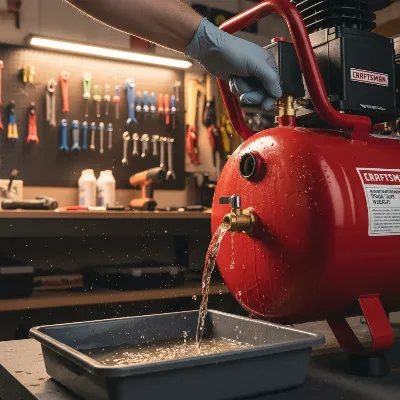 A user demonstrates draining water from a Craftsman air compressor tank after use, emphasizing safety and regular maintenance. The scene shows the drain valve open, with a small amount of water coming out into a container, in a well-lit workshop.
Conclusion
The Craftsman 6-gallon pancake air compressor stands out as a highly capable and user-friendly tool, perfectly suited for the demands of DIY enthusiasts and light professional tasks. Its oil-free pump ensures minimal maintenance, while the compact, portable design and quick recovery time make it a joy to use for everything from inflating tires to powering various nail guns. While its noise level and smaller tank size compared to industrial units are minor considerations, the overall value, performance, and included accessories solidify its position as an excellent choice for a home workshop or job site. Are you ready to streamline your projects with this reliable power source?
Frequently Asked Questions
Is the Craftsman 6-gallon pancake compressor good for painting?
The Craftsman 6-gallon pancake compressor can handle light-duty paint spraying, particularly for smaller projects like touch-ups or crafts, thanks to its 150 PSI and 2.6 SCFM. However, for larger painting projects requiring continuous, high-volume airflow and consistent pressure, a compressor with a higher SCFM and larger tank might be more suitable to avoid frequent cycling and ensure a smooth finish.
How loud is the Craftsman 6-gallon pancake compressor?
The Craftsman 6-gallon pancake compressor has a stated noise level of approximately 78.5 dB. While this is typical for many portable piston compressors, it can be considered loud, especially when operating in enclosed spaces like a garage. It is highly recommended to wear appropriate hearing protection during extended use to prevent discomfort or potential hearing damage.
Can I use an extension cord with my Craftsman air compressor?
Yes, the Craftsman 6-gallon pancake compressor is designed with a low-amp motor that can start easily even with an extension cord. However, for optimal performance and safety, always use an extension cord that is rated for outdoor use, is the correct gauge (typically 12 or 14 gauge for shorter runs), and is as short as possible to minimize voltage drop.
How often should I drain my air compressor tank?
It is crucial to drain the Air Compressor tank daily or after each use. This practice removes condensed moisture that accumulates inside the tank, preventing rust and corrosion. Regularly draining the tank significantly extends the lifespan of your compressor and helps maintain its operational integrity, as a compromised tank can be a serious safety hazard.
What tools can I run with a 6-gallon pancake compressor?
A 6-gallon pancake compressor like the Craftsman is ideal for a wide range of light-to-medium pneumatic tools. This includes inflating tires, powering brad nailers, finish nailers, and staplers for woodworking and trim work, using blow guns for cleaning, and running airbrushes. It is generally not recommended for heavy-duty tools like framing nailers (for continuous use), sandblasters, or large paint sprayers that demand higher, sustained SCFM.