Stepping into the world of air compressors can be a confusing journey, especially with the array of portable options available. For many DIY enthusiasts and professionals alike, the choice often narrows down to two popular contenders: the pancake and twin stack air compressors. These compact units are staples in workshops and job sites, each offering distinct advantages tailored to different tasks. But how do you decide which one is the right fit for your specific needs? Understanding their unique designs, power delivery, and intended applications is key to making an informed decision that will empower your projects and enhance your efficiency.
General Overview of Air Compressors
Air compressors are indispensable tools that convert power, typically from an electric motor, into potential energy stored in pressurized air. This compressed air is then used to power pneumatic tools, inflate tires, and perform various other tasks. Key performance indicators for any air compressor include Cubic Feet per Minute (CFM), which measures the volume of air the compressor can deliver at a certain pressure, and Pounds per Square Inch (PSI), indicating the maximum pressure the tank can hold. The tank capacity, measured in gallons, determines how much air can be stored, directly impacting how long a tool can run before the compressor needs to cycle and refill. For portable applications, size, weight, and noise levels are also crucial factors.
Understanding Pancake Air Compressors
Pancake air compressors are easily recognizable by their flat, round tank design, which gives them their distinctive name. This compact shape is not just for aesthetics; it contributes significantly to their stability and portability, making them a favorite among homeowners and DIYers.
Piston-driven, these compressors operate by using a motor to move a piston that compresses air into the tank. This design prioritizes ease of use and low maintenance, often featuring oil-free pumps that eliminate the need for regular oil changes. The low center of gravity provided by the pancake tank also makes these units remarkably stable, reducing the risk of tipping during operation or transport.
Advantages of Pancake Air Compressors
|
Our Picks for the Best Air Compressor in 2026
As an Amazon Associate I earn from qualifying purchases.
|
||
| Num | Product | Action |
|---|---|---|
| 1 | Quiet Air Compressor, Only 68dB, 5 Gallon Steel Tank, 2.8CFM @ 90PSI, Oil-Free, Electric Air Compressor Perfect for Woodwork Nailing, Garage, Car, Pneumatic Tool, Includes 11 Accessories |

|
| 2 | DEWALT Tire Inflator Portable Air Compressor 20V MAX, Car Air Pump with Automatic Shut Off, LED Light, Tool Only (DCC020IB) |
|
| 3 | Tire Inflator Portable Air Compressor, 150PSI Cordless Air Pump for Car Tires with Auto Shut-Off, Portable Tire Pump for Car, Bike, Motorcycle and Balls |
|
| 4 | Craftsman Air Compressors 6 Gallon Portable Pancake Air Compressor,Oil Free Max 150 Psi 1.0HP 2.6 CFM@90PSI Electric Air Compressor Shop Air Compressor, CMXECXA02106410 |
|
| 5 | AC Compressor for 2000-2027 Chevy Silverado/GMC Sierra/Cadillac Escalade (4.8L/5.3L/6.0L V8) | OE Replaces 15036042, 15707611, CO29002C,78363, 78362 | A/C Compressor & Kit |
|
| 6 | Metabo HPT Pancake Air Compressor, 6-Gallon 165PSI, Portable Air Compressor with 1.0 HP Oil-Free High Efficiency Motor, Lihghtweight, Quick Couplers for Fast Tool Changes, EC711S |
|
| 7 | ECOMAX Air Compressor 6 Gallon 150 PSI Pancake Portable Oil-free Tank with 10 PCS Accessories Kit |
|
| 8 | CRAFTSMAN Air Compressor, 2 Gallon Portable Air Compressor 1/3HP Max 125 PSI Oil-Free Light Weight with 10 PCS Accessory Kit |
|
| 9 | Airmoto Tire Inflator Portable Air Compressor - Air Pump for Car Tires with Digital Pressure Gauge, LED Light and Auto Shut-Off Function - Cordless Pump for Car, Motorcycle, Bicycle, Ball |
|
| 10 | California Air Tools CAT-4710W 1.0 HP Quiet and Oil-Free Air Compressor with Wheels, 4.7 Gallon Steel Tank, 75 dBA Noise Level, Lightweight |
|
One of the most compelling benefits of pancake compressors is their high portability and compact design. Their lightweight nature, often around 30-40 pounds, makes them easy to carry from one location to another, or even up a ladder. This small footprint also translates to excellent storage convenience, fitting neatly under a workbench or in a tight corner without consuming much space.
Furthermore, many pancake compressors are designed with oil-free pumps, drastically reducing maintenance requirements. This means you can spend more time working and less time on messy oil changes. While they might not be whisper-quiet, they generally offer quieter operation compared to their hot dog or twin stack counterparts, typically ranging from 60-80 decibels. This noise level is comparable to a normal conversation, making them more suitable for indoor use or residential areas where noise reduction is a priority.
Disadvantages of Pancake Air Compressors
Despite their many benefits, pancake compressors do have limitations. Their smaller air tank capacity, typically 2-4 gallons, means they offer a more limited supply of air, which can result in slower recovery times for continuous use. This means the compressor will need to cycle more frequently to maintain pressure, potentially interrupting workflow for more demanding tasks. Consequently, they provide less power for heavy-duty tools that require a constant, high volume of air.
Suitable Applications
Pancake air compressors are ideally suited for light to medium-duty tasks that don’t demand a continuous, high volume of air. They are perfect for inflating car tires, bike tires, and sports equipment. For woodworking and finish work, they excel at powering brad nailers and staplers. They can also handle small painting jobs and a variety of light DIY projects around the house or garage, such as blowing dust off a workbench or clearing debris.
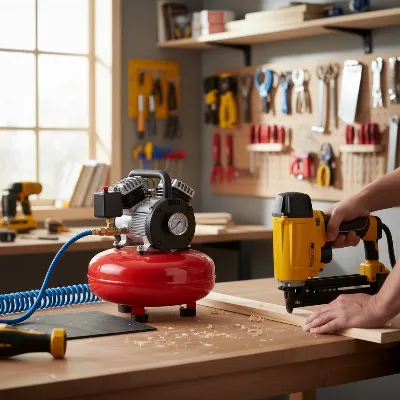 Pancake air compressor in use for a light DIY project, illustrating its compact size and portability
Exploring Twin Stack Air Compressors
Twin stack air compressors, as the name suggests, feature two cylindrical air tanks, typically stacked either horizontally or vertically. This design aims to provide a greater air reservoir than single-tank portable models while still offering a degree of mobility. The motor and pump assembly are often mounted low on the frame, which helps protect the components and contributes to the unit’s overall stability.
These compressors bridge the gap between smaller portable units and larger stationary compressors, delivering enhanced performance for more demanding tasks. They can utilize either single-stage or two-stage compression, with two-stage models offering higher pressures and greater efficiency under constant load, often found in more professional-grade twin stack units.
Advantages of Twin Stack Air Compressors
The primary advantage of twin stack compressors is their higher air capacity and ability to maintain sustained pressure due to having two tanks. This increased air storage translates to longer tool runtimes without the pump cycling as frequently, making them better suited for tools that require a more continuous air supply. They provide greater power for demanding tools such as framing nailers, roofing nailers, sanders, and paint sprayers.
Many twin stack models are built with enhanced durability, particularly those with oil-lubricated pumps, which tend to have a longer lifespan compared to their oil-free counterparts. Their robust construction and higher CFM output make them incredibly versatile, capable of handling a broader range of medium to heavy-duty tasks that might overwhelm a pancake compressor. Twin stack compressors often also feature multiple air outlets, allowing two tools to be run simultaneously, boosting productivity on a job site.
Disadvantages of Twin Stack Air Compressors
While powerful, twin stack compressors are notably heavier and bulkier than pancake models, often weighing between 60 to over 100 pounds. While many come equipped with wheels and handles for transport, their increased weight and larger footprint make them less genuinely portable and harder to lift into vehicles or onto elevated work areas. This increased power and capacity often comes with a higher cost compared to pancake units. Additionally, they can be potentially noisier, with noise levels typically ranging from 70-90 decibels, which might be disruptive in quiet environments. If equipped with an oil-lubricated pump, they will also require more regular maintenance, including oil checks and changes.
Suitable Applications
Twin stack air compressors are a preferred choice for professionals and serious DIYers tackling more intensive projects. They are ideal for framing and roofing applications where powerful nail guns are used continuously. For automotive work, they can power impact wrenches and grinders. They are also excellent for finish carpentry using trim nailers, paint spraying, and even small construction or remodeling sites where a consistent and robust air supply is crucial for tools like flooring nailers or small sandblasters.
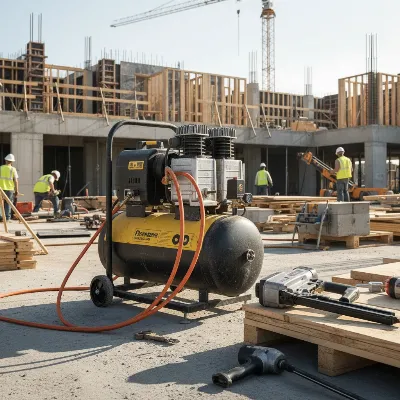 Twin stack air compressor on a busy construction site with pneumatic tools
Comparison Table: Pancake vs. Twin Stack Air Compressors
Choosing between these two popular portable air compressor types often boils down to balancing portability with power and capacity. Here’s a detailed comparison to help clarify the differences:
| Feature | Pancake Air Compressor | Twin Stack Air Compressor |
|---|---|---|
| Tank Design | Flat, round, single tank | Two cylindrical tanks (stacked horizontally or vertically) |
| Air Capacity | Smaller (2-4 gallons typical) | Larger (4-10+ gallons typical) |
| Portability | Excellent (lightweight, easy to carry, stable) | Good (heavier, often with wheels/handles, less nimble) |
| Power (CFM) | Lower (e.g., 2.0-2.6 CFM at 90 PSI) | Higher (e.g., 4.0+ CFM at 90 PSI) |
| Max PSI | ~150 PSI (some higher-end models reach 200 PSI) | 120-175+ PSI |
| Noise Level | Generally quieter (60-80 dB) | Generally louder (70-90 dB) |
| Maintenance | Low (often oil-free, no oil changes) | Variable (oil-free or oil-lubricated, more maintenance for oiled) |
| Cost | Generally lower, budget-friendly | Generally higher, reflecting increased power/capacity |
| Applications | Inflating, brad nailing, stapling, light DIY, trim work | Framing, roofing, sanders, heavy-duty projects, automotive |
How to Choose the Right Air Compressor
Selecting the ideal air compressor involves a thoughtful assessment of your specific needs, the tools you plan to use, and your working environment.
Determine Your Usage Needs
Start by clearly defining what you’ll use the compressor for.
- Tools You’ll Power: Every pneumatic tool has specific CFM and PSI requirements. A brad nailer needs far less air than a framing nailer or a paint sprayer. Always check the tool’s specifications and choose a compressor that meets or slightly exceeds the highest CFM requirement of your most demanding tool.
- Duration of Use: Will you be using the compressor for intermittent bursts of air, like inflating tires, or for continuous tasks such as prolonged nailing or sanding? For continuous use, a larger tank and higher CFM will be essential to prevent constant cycling and maintain steady pressure.
- Portability Requirements: Do you need to frequently move the compressor around a large job site, carry it upstairs, or transport it in a vehicle? If so, lighter, more compact options are preferable. If it will mostly stay in one spot, weight is less of a concern.
- Workspace Environment: Is noise a significant factor? If you’re working indoors, in a residential area, or near others, a quieter compressor will be a major advantage.
Key Specifications to Consider
Once you understand your usage, focus on the technical specifications.
- CFM (Cubic Feet per Minute): This is arguably the most critical factor. Ensure the compressor’s CFM output at 90 PSI (a common benchmark) is equal to or greater than the CFM requirements of your most air-intensive tool. Adding a 20-30% buffer is recommended for optimal performance.
- PSI (Pounds per Square Inch): Confirm that the maximum PSI rating aligns with the operating pressure requirements of your tools. Most pneumatic tools operate between 70-100 PSI.
- Tank Size (Gallons): A larger tank provides more reserve air, leading to longer runtimes between pump cycles and less frequent refilling. For light, intermittent tasks, a smaller tank is fine. For continuous work, a larger tank is beneficial.
- Power Source: For portable units, electric (corded) is standard. Ensure your power supply can handle the compressor’s electrical demands.
- Oil-Lubricated vs. Oil-Free: Oil-free compressors are low maintenance, lighter, and often more affordable but might have a shorter lifespan. Oil-lubricated models are typically more durable and longer-lasting, quieter, and run cooler, but require regular oil changes and are heavier.
Budget and Brands
Your budget will naturally influence your choice. Pancake compressors are generally more affordable, making them an excellent entry-level option. Twin stack units, with their increased power and capacity, typically come at a higher price point.
When it comes to brands, several manufacturers have a strong reputation for producing reliable portable air compressors. Look for names like Porter-Cable, Craftsman, Metabo HPT (especially “The Tank” for higher-end pancake performance), DeWalt, and Makita. Always prioritize a brand known for quality and ensure the product comes with a solid warranty and accessible customer support. A good warranty provides peace of mind, protecting your investment against potential defects.
Usage and Maintenance Tips for Portable Air Compressors
Proper usage and regular maintenance are crucial for maximizing the lifespan and efficiency of any air compressor, regardless of type.
- Safety First: Always read the owner’s manual thoroughly before operating your compressor. Wear appropriate personal protective equipment, especially eye protection, to guard against flying debris. Ensure adequate ventilation in your workspace to prevent overheating.
- Drain the Tank Regularly: Condensation forms inside the air tank, especially in humid environments. This water can lead to rust and corrosion, compromising the tank’s integrity. Make it a habit to drain the air tank after every use or at least weekly by opening the drain valve located at the bottom of the tank. This simple step is vital for extending the compressor’s life.
- Check for Leaks: Periodically inspect all hoses, fittings, and connections for air leaks. Even small leaks can cause the compressor to run more frequently, increasing wear and energy consumption. Soapy water can be sprayed on connections to easily spot bubbles indicating a leak.
- Clean or Replace Air Filter: The air filter prevents dust and debris from entering the pump. A clogged filter can reduce efficiency and put a strain on the motor. Check the filter regularly and clean or replace it according to the manufacturer’s recommendations.
- Oil-Lubricated Models: If your twin stack compressor is oil-lubricated, diligently follow the manufacturer’s guidelines for checking oil levels and performing oil changes. Using the correct type and amount of oil is essential for proper lubrication and preventing premature wear.
“Many users overlook the simple act of draining the air tank, but it’s perhaps the most critical maintenance step to ensure the longevity and safety of your air compressor. Rust inside the tank can be a silent killer.” – John Peterson, Master Technician, ReviewBuying.com
Conclusion
The decision between a pancake and twin stack air compressor ultimately hinges on your specific project requirements. Pancake compressors excel in portability, stability, and low maintenance, making them the perfect companion for light-duty tasks around the home and smaller DIY projects where quiet operation and ease of transport are paramount. Their compact design is ideal for quick inflation tasks, brad nailing, and general utility.
Conversely, twin stack compressors offer superior air capacity and sustained power, making them indispensable for heavier-duty applications that demand a consistent air supply, such as framing, roofing, or operating high-CFM tools. While heavier and potentially noisier, their robust performance and durability often justify the trade-offs for professional use or serious woodworking. By carefully considering the CFM and PSI requirements of your tools, the duration of your tasks, and the importance of portability and noise in your workspace, you can confidently select the air compressor that will serve you best. What kind of project are you planning that needs reliable compressed air?
Frequently Asked Questions
Can a pancake compressor run a framing nailer?
While some newer, high-performance pancake compressors (like specific Metabo HPT models) claim they can run framing nailers for limited use, generally, a standard pancake compressor is not recommended for extended framing nailer operation. Framing nailers require a higher CFM and continuous air supply that twin stack compressors are better equipped to provide, ensuring consistent nail driving without pressure drops.
Are twin stack compressors really much heavier?
Yes, twin stack compressors are significantly heavier than pancake models. A pancake compressor typically weighs 30-40 pounds, whereas a twin stack can easily weigh 60 pounds or more, with some models exceeding 100 pounds. However, most twin stack units are equipped with wheels and handles to mitigate this weight and improve their mobility on job sites.
How often should I drain my air compressor tank?
It is highly recommended to drain your air compressor tank after every use. If you use it less frequently, aim to drain it at least weekly. This prevents the buildup of condensation inside the tank, which can lead to rust and corrosion, significantly shortening the compressor’s lifespan and potentially posing a safety hazard.
What does “oil-free” mean for an air compressor?
An “oil-free” air compressor means that its pump operates without any lubricating oil. This design choice results in lower maintenance requirements (no messy oil changes) and lighter units. While convenient, some argue that oil-lubricated pumps may offer a longer overall lifespan due to reduced friction, though modern oil-free designs have made significant durability advancements.
Can I use a portable air compressor for painting?
Yes, you can use a portable Air Compressor for painting, but you must ensure that its CFM and tank size match the requirements of your specific paint sprayer. Smaller pancake compressors might be suitable for touch-up guns or very small projects, but for continuous or larger painting jobs, a twin stack compressor with higher CFM and a larger tank will provide the sustained airflow needed for an even finish and prevent frequent cycling.