Transforming your garage into a high-performance workspace often begins with a critical upgrade: a well-designed compressed air system. If you’re tired of tripping over hoses or dealing with inconsistent airflow, it’s time to route dedicated air compressor lines. This DIY guide will walk you through every step, ensuring you build a safe, efficient, and professional-grade air distribution network that makes your air tools always ready when you are.
Understanding Air Compressor Line Systems
A permanent air compressor line system in your garage provides a centralized, efficient way to deliver compressed air to various workstations without the clutter of portable hoses. It consists of a main line running from your compressor, with “drop” lines extending down to quick-connect outlets where you can attach your air tools. This setup ensures consistent pressure, reduces safety hazards, and optimizes your workflow.
The core principle involves minimizing pressure drops and ensuring that any moisture in the air has a place to drain. Proper planning and material selection are crucial to achieving a system that is both reliable and safe for years of demanding use.
Planning Your Garage Air System
Before you even think about cutting pipe, a detailed plan is your most valuable tool. This phase sets the foundation for an efficient, leak-free, and practical air system tailored to your specific needs.
Assessing Your Air Tool Needs
|
Our Picks for the Best Air Compressor in 2026
As an Amazon Associate I earn from qualifying purchases.
|
||
| Num | Product | Action |
|---|---|---|
| 1 | Quiet Air Compressor, Only 68dB, 5 Gallon Steel Tank, 2.8CFM @ 90PSI, Oil-Free, Electric Air Compressor Perfect for Woodwork Nailing, Garage, Car, Pneumatic Tool, Includes 11 Accessories |

|
| 2 | DEWALT Tire Inflator Portable Air Compressor 20V MAX, Car Air Pump with Automatic Shut Off, LED Light, Tool Only (DCC020IB) |
|
| 3 | Airmoto Tire Inflator Portable Air Compressor - Air Pump for Car Tires with Digital Pressure Gauge, LED Light and Auto Shut-Off Function - Cordless Pump for Car, Motorcycle, Bicycle, Ball |
|
| 4 | AC Compressor for 2000-2027 Chevy Silverado/GMC Sierra/Cadillac Escalade (4.8L/5.3L/6.0L V8) | OE Replaces 15036042, 15707611, CO29002C,78363, 78362 | A/C Compressor & Kit |
|
| 5 | Tire Inflator Portable Air Compressor, 150PSI Cordless Air Pump for Car Tires with Auto Shut-Off, Portable Tire Pump for Car, Bike, Motorcycle and Balls |
|
| 6 | Metabo HPT Pancake Air Compressor, 6-Gallon 165PSI, Portable Air Compressor with 1.0 HP Oil-Free High Efficiency Motor, Lihghtweight, Quick Couplers for Fast Tool Changes, EC711S |
|
| 7 | California Air Tools CAT-4710W 1.0 HP Quiet and Oil-Free Air Compressor with Wheels, 4.7 Gallon Steel Tank, 75 dBA Noise Level, Lightweight |
|
| 8 | CRAFTSMAN Air Compressor, 2 Gallon Portable Air Compressor 1/3HP Max 125 PSI Oil-Free Light Weight with 10 PCS Accessory Kit |
|
| 9 | Craftsman Air Compressors 6 Gallon Portable Pancake Air Compressor,Oil Free Max 150 Psi 1.0HP 2.6 CFM@90PSI Electric Air Compressor Shop Air Compressor, CMXECXA02106410 |
|
| 10 | ECOMAX Air Compressor 6 Gallon 150 PSI Pancake Portable Oil-free Tank with 10 PCS Accessories Kit |
|
Start by evaluating the air tools you currently own or plan to acquire. Each pneumatic tool has specific requirements for cubic feet per minute (CFM) and pounds per square inch (PSI). Your air compressor’s CFM output is particularly important, as it dictates how many tools you can run simultaneously and for how long. Most air tools operate efficiently at or below 90 PSI, so focus on matching your compressor’s CFM output to the combined demands of your most frequently used tools. Consider the tank volume of your compressor as well; a larger tank provides a greater reserve of air, reducing how often the compressor cycles on and off during use.
Designing Your Layout
Sketch out your garage layout, marking the ideal location for your air compressor, main air lines, and drop points.
- Compressor Placement: Choose a dry, well-ventilated area, preferably on a flat, solid surface to minimize vibration and noise. Ensure there’s adequate space around it for airflow and maintenance.
- Main Line Path: Run the main line along the walls or ceiling. A “loop” design, where the main line circles the perimeter and connects back to the compressor, helps maintain more even pressure throughout the system.
- Sloping for Drainage: It’s vital to install main lines with a slight slope (about 1 inch per 10 feet) towards a drain point. This allows condensation, which naturally forms in compressed air systems, to collect and be easily drained, preventing it from reaching your tools and causing damage.
- Drop Locations: Identify all points where you’ll need air access—near workbenches, specific machines, or even your garage door for tire inflation. Each drop should include a shut-off valve, a quick coupler, and ideally, a filter/regulator. Position these outlets at a comfortable working height, typically 36 to 48 inches from the floor.
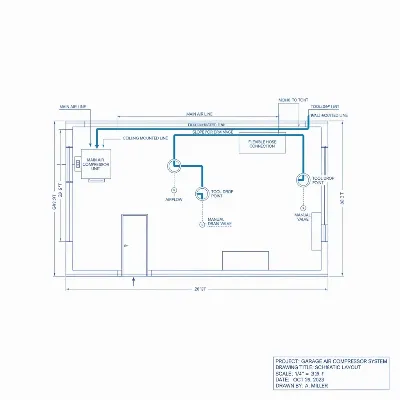 Detailed blueprint of a garage air compressor line layout showing main lines, drop lines, and compressor placement
Choosing the Right Piping Materials
The longevity and performance of your compressed air system heavily depend on the piping material you choose. Different materials offer varying benefits in terms of cost, durability, and ease of installation.
Aluminum Piping
Aluminum piping systems are gaining popularity among DIYers and professionals alike.
- Advantages: They are lightweight, corrosion-resistant, and feature push-to-connect fittings that make installation incredibly fast and easy, often without the need for special tools or threading. Aluminum provides excellent laminar flow due to its smooth interior.
- Disadvantages: The initial cost can be higher than some traditional options.
- Applications: Ideal for clean air applications and workshops where quick, flexible installation and leak-free operation are priorities.
Copper Piping
Copper has long been a reliable choice for plumbing and compressed air systems.
- Advantages: It’s corrosion-free, relatively lightweight, and easy to cut, solder, or press with special fittings. It also has a smooth interior for good airflow.
- Disadvantages: Its cost has increased significantly, and installation can be more labor-intensive compared to modular systems. It also has a higher coefficient of expansion than aluminum, requiring more material for larger installations to compensate.
- Applications: Recommended for clean air applications where durability and corrosion resistance are key, and a traditional, permanent installation is desired.
Black Iron Pipe
Black iron pipe is a traditional, robust option.
- Advantages: It is strong, durable, and widely available. Many DIYers are familiar with its installation methods.
- Disadvantages: It is heavy, susceptible to internal corrosion over time (which can lead to rust flakes in the air stream), and threaded connections can be prone to leaks if not properly sealed. Installation is labor-intensive, requiring threading tools.
- Applications: Suitable for heavy-duty industrial applications where robust construction is paramount, but less ideal for systems requiring ultra-clean air or easy modification.
PEX/ABS/PE/HDPE (Plastic) Tubing
While not all plastic pipes are suitable, specific types of plastic tubing can be used for compressed air.
- Advantages: Lightweight, non-corrosive, and generally easy to install. PEX-AL-PEX (a composite of PEX and aluminum) combines flexibility with structural integrity. ABS, PE, and HDPE piping are also good choices for certain applications.
- Disadvantages: PVC pipe is extremely dangerous and strictly not recommended for compressed air due to its tendency to become brittle and explode under pressure, creating hazardous shrapnel. Always ensure any plastic piping is specifically rated for compressed air applications.
- Applications: Good for smaller workshops or specialized runs where flexibility and ease of installation are valued, provided the material is specifically designed and rated for compressed air.
Comparison of Air Line Materials
Choosing the right material is a balance of performance, cost, and installation effort. This table offers a quick comparison:
| Material | Pros | Cons | Installation Ease | Cost | Application |
|---|---|---|---|---|---|
| Aluminum Pipe | Lightweight, corrosion-resistant, smooth flow, easy push-to-connect | Higher initial cost | Very Easy (DIY-friendly) | Medium-High | Clean air, flexible systems, quick install, modern shops |
| Copper Pipe | Corrosion-free, smooth flow, lightweight, widely available fittings | High cost, can be labor-intensive (soldering/pressing) | Moderate | High | Clean air, permanent installations, traditional workshops |
| Black Iron Pipe | Strong, durable, familiar installation | Heavy, susceptible to internal corrosion, prone to leaks, labor-intensive | Difficult | Low-Medium | Heavy-duty industrial, less critical air quality |
| PEX/ABS/PE/HDPE | Lightweight, non-corrosive, flexible, easy to install | PVC is DANGEROUS. Other plastics must be specifically rated | Easy | Low-Medium | Smaller shops, specific runs, where flexibility is needed |
Step-by-Step Installation Guide
Once you’ve meticulously planned your system and chosen your materials, the installation process becomes a systematic execution of your design. Safety and precision are paramount at every stage.
Safety First: Essential Precautions and Tools
Before starting, ensure you have the right safety gear and tools:
- Safety Glasses and Hearing Protection: Always wear eye and ear protection when working with power tools and compressed air.
- Gloves: Protect your hands from cuts and abrasions.
- Tools: Pipe cutters (specific to your material), wrenches, measuring tape, level, drill, mounting hardware (clips, anchors), thread sealant (if applicable), and leak detection spray.
- Safety Check: Ensure your air compressor is unplugged and fully depressurized before making any connections. Never work on a pressurized system.
- Ventilation: Work in a well-ventilated area, especially if you’re soldering or using adhesives.
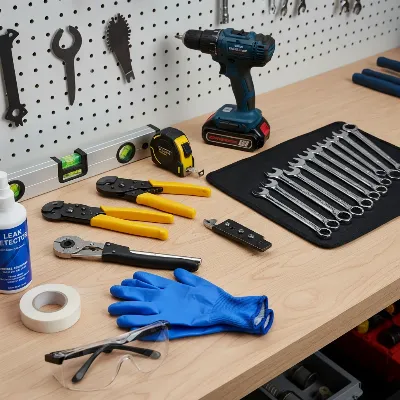 A collection of essential tools for DIY air compressor line installation, including pipe cutters, wrenches, and safety glasses
Mounting the Compressor and Main Line
- Compressor Placement: Secure your air compressor on a flat, level surface. Using isolation pads can help reduce vibrations and noise. Ensure it has plenty of clear space for adequate ventilation.
- Initial Connection: Connect a short, high-temperature flexible hose from your compressor’s outlet to the beginning of your main air line. This flex hose absorbs vibrations and accommodates any slight movement of the compressor.
- Mounting the Main Line: Begin installing the longest straight runs of pipe first. Secure the main line along your chosen path (walls or ceiling) using appropriate mounting hardware (clips, brackets) at regular intervals (every 3-4 feet). Remember to incorporate the slight downward slope towards a planned drain point.
- Fittings: Use elbow fittings for corners and tee fittings at every location where a drop line will be installed. For threaded connections, apply a generous amount of high-quality thread sealant or PTFE tape to ensure an airtight seal.
Installing Drop Lines, Outlets, and Accessories
- Drop Lines: From each tee fitting on the main line, run a vertical “drop” line downwards. These drops should also have a slight slope towards their base to facilitate moisture drainage.
- Drain Points: At the bottom of each drop line (or at the lowest point of your main line loop), install a ball valve or a dedicated auto-drain mechanism. This is critical for regularly draining condensate and preventing water from reaching your tools.
- Filters and Regulators: Install an air filter immediately after the compressor and potentially at each drop point, especially for sensitive tools like paint sprayers. A pressure regulator should be installed after the filter to control the air pressure delivered to your tools, typically set to 90 PSI. An air dryer might also be beneficial to further remove moisture, particularly in humid environments.
- Outlets: At a comfortable height on each drop, install a shut-off valve followed by a quick coupler. This allows you to easily connect and disconnect air tools and isolate sections of the system for maintenance. Consider adding retractable hose reels near frequently used workstations for convenience.
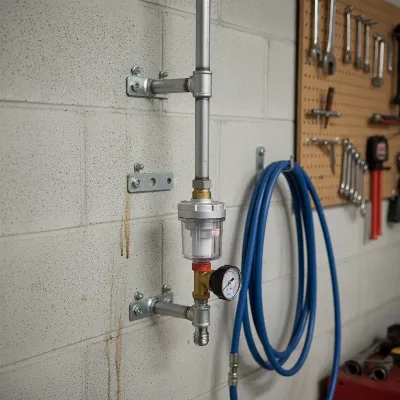 A garage wall showing a routed air compressor drop line with a filter, regulator, and quick-connect coupling for tools
Pressure Testing Your System
After all components are installed, it’s crucial to pressure test your entire system for leaks.
- Pressurize: Slowly pressurize the system to its operating pressure.
- Leak Detection: Spray a soapy water solution on all connections, fittings, and joints. Bubbles indicate a leak that needs to be tightened or re-sealed. This step is vital to prevent air loss, which can make your compressor run constantly and increase energy costs.
Maintenance and Longevity for Your Air System
A well-maintained air compressor system will serve your garage for many years, ensuring peak performance and preventing costly repairs. Simple, routine checks can make a significant difference in its lifespan and efficiency.
One of the most critical maintenance tasks is draining condensate from the compressor tank and any drain points in your piping system. Compressed air inevitably produces moisture, which, if left to accumulate, can lead to rust inside the tank and piping, contaminate your tools, and reduce overall system efficiency. This should be done daily or weekly depending on usage and humidity.
Regularly inspect all hoses and connections for any signs of wear, cracks, or loose fittings. Even minor leaks can significantly impact your compressor’s performance and energy consumption. Use the soapy water test periodically to identify and address any new leaks. Additionally, check and replace air filters—both the intake filter on your compressor and any in-line filters in your piping system—according to the manufacturer’s recommendations. Clean air intake prevents dust and debris from damaging internal compressor components, while clean in-line filters ensure your tools receive contaminant-free air.
> “A properly designed and maintained compressed air system isn’t just a convenience; it’s an investment in your productivity and safety. Ignoring small leaks or neglecting drainage can lead to significant energy waste and premature equipment failure.” – John Doe, Master Technician at ReviewBuying.com
Conclusion
Routing Air Compressor lines in your garage is a rewarding DIY project that significantly upgrades your workspace. By carefully planning your layout, selecting the right piping materials, following a meticulous installation process, and committing to regular maintenance, you can create a safe, efficient, and reliable air distribution system. This transformation not only streamlines your work but also enhances the lifespan of your air tools and compressor, providing consistent power right where you need it. Ready to power up your garage? What project will your new compressed air system tackle first?
Frequently Asked Questions
Why is PVC pipe not recommended for compressed air lines?
PVC pipe is not recommended and is considered dangerous for compressed air systems because it can become brittle over time and may explode under pressure, creating hazardous shrapnel. It is not designed to withstand the internal pressures and stresses of compressed air.
How often should I drain the condensate from my air compressor system?
Condensate should be drained from your compressor tank daily or weekly, depending on usage frequency and environmental humidity. Any drain points in your main air lines should also be drained regularly to prevent moisture buildup in your system.
What is the advantage of a “loop” design for garage air lines?
A loop design, where the main air line runs around the perimeter of your garage and connects back to the compressor, helps maintain more consistent pressure throughout the system. It allows air to flow from two directions to any drop point, reducing pressure drop.
Do I need a filter and regulator at every drop point?
While a main filter and regulator near the compressor are essential, adding dedicated filters and regulators at each drop point provides localized control and cleaner air for specific tools, which is particularly beneficial for sensitive equipment like paint sprayers or plasma cutters.
How can I easily detect leaks in my compressed air system?
The simplest way to detect leaks is to spray a soapy water solution on all connections, fittings, and joints when the system is pressurized. Any visible bubbles indicate an air leak that needs to be tightened or re-sealed.