Air compressors are indispensable workhorses, powering everything from DIY projects in your garage to complex machinery on industrial factory floors. They convert electrical or engine power into kinetic energy by compressing and storing air, which is then released in powerful bursts to operate pneumatic tools, paint sprayers, and various industrial equipment. However, like any precision machinery, an air compressor’s efficiency, safety, and lifespan are profoundly dependent on consistent, proper maintenance. Neglecting these crucial checks can lead to unexpected breakdowns, costly repairs, decreased performance, and even safety hazards.
This comprehensive guide will equip you with the knowledge to understand, maintain, and troubleshoot your air compressor, ensuring it runs smoothly for years to come. We will examine the different types of compressors, outline a clear maintenance schedule, and provide practical tips to keep your investment in peak condition.
Overview of Air Compressors
At its core, an air compressor works by drawing in ambient air and compressing it into a smaller volume, increasing its pressure. This high-pressure air is then stored in a receiver tank, ready to be delivered on demand. The fundamental principle involves converting power (from an electric motor or gas engine) into potential energy stored in compressed air.
There are several primary types of air compressors, each designed for specific applications and operational demands. The most common include piston (reciprocating), rotary screw, and centrifugal compressors. Piston compressors use a reciprocating piston within a cylinder to compress air, while rotary screw compressors utilize two interlocking helical rotors. Centrifugal compressors, on the other hand, accelerate air to high speeds with a rotating impeller to achieve compression. These machines are vital across a wide range of sectors, from powering construction tools and automotive repair equipment to driving critical processes in manufacturing, medical, and dental industries.
Classifying Air Compressors
Understanding the different types of air compressors is key to effective maintenance and selecting the right unit for your needs. Each type has distinct operational characteristics, advantages, and maintenance requirements.
Piston Air Compressors
Piston air compressors, also known as reciprocating compressors, are among the most common types, especially in smaller workshops and for portable applications. They operate using pistons that move within cylinders to compress air. These can be single-stage or two-stage, offering varying levels of pressure.
- Advantages: Piston compressors are known for their robust and durable construction, making them reliable for intermittent usage. They are generally more affordable upfront and are suitable for tasks that do not require continuous airflow.
- Disadvantages: These compressors have more moving parts, which can lead to higher wear and tear over time. They are typically not designed for continuous use and can be noisier than other types.
- Suitable Applications: Ideal for home garages, small construction projects, powering basic pneumatic tools, and woodworking shops where air demand is intermittent rather than constant.
Rotary Screw Air Compressors
|
Our Picks for the Best Air Compressor in 2026
As an Amazon Associate I earn from qualifying purchases.
|
||
| Num | Product | Action |
|---|---|---|
| 1 | AC Compressor for 2000-2027 Chevy Silverado/GMC Sierra/Cadillac Escalade (4.8L/5.3L/6.0L V8) | OE Replaces 15036042, 15707611, CO29002C,78363, 78362 | A/C Compressor & Kit |

|
| 2 | Quiet Air Compressor, Only 68dB, 5 Gallon Steel Tank, 2.8CFM @ 90PSI, Oil-Free, Electric Air Compressor Perfect for Woodwork Nailing, Garage, Car, Pneumatic Tool, Includes 11 Accessories |
|
| 3 | ECOMAX Air Compressor 6 Gallon 150 PSI Pancake Portable Oil-free Tank with 10 PCS Accessories Kit |
|
| 4 | DEWALT Tire Inflator Portable Air Compressor 20V MAX, Car Air Pump with Automatic Shut Off, LED Light, Tool Only (DCC020IB) |
|
| 5 | CRAFTSMAN Air Compressor, 2 Gallon Portable Air Compressor 1/3HP Max 125 PSI Oil-Free Light Weight with 10 PCS Accessory Kit |
|
| 6 | California Air Tools CAT-4710W 1.0 HP Quiet and Oil-Free Air Compressor with Wheels, 4.7 Gallon Steel Tank, 75 dBA Noise Level, Lightweight |
|
| 7 | Metabo HPT Pancake Air Compressor, 6-Gallon 165PSI, Portable Air Compressor with 1.0 HP Oil-Free High Efficiency Motor, Lihghtweight, Quick Couplers for Fast Tool Changes, EC711S |
|
| 8 | Airmoto Tire Inflator Portable Air Compressor - Air Pump for Car Tires with Digital Pressure Gauge, LED Light and Auto Shut-Off Function - Cordless Pump for Car, Motorcycle, Bicycle, Ball |
|
| 9 | Craftsman Air Compressors 6 Gallon Portable Pancake Air Compressor,Oil Free Max 150 Psi 1.0HP 2.6 CFM@90PSI Electric Air Compressor Shop Air Compressor, CMXECXA02106410 |
|
| 10 | Tire Inflator Portable Air Compressor, 150PSI Cordless Air Pump for Car Tires with Auto Shut-Off, Portable Tire Pump for Car, Bike, Motorcycle and Balls |
|
Rotary screw air compressors are the workhorses of industrial settings, designed for continuous, high-volume operation. They utilize two interlocking helical rotors that trap air and reduce its volume to increase pressure. These compressors are available in both oil-lubricated and oil-free configurations.
- Advantages: Rotary screw compressors are highly efficient and provide a continuous, stable airflow, making them excellent for demanding industrial applications. They are generally quieter than piston compressors and have fewer pulsating airflows. Oil-free versions are crucial for sensitive environments requiring pristine air quality.
- Disadvantages: These units typically have a higher initial cost compared to piston compressors. Oil-lubricated models require regular oil changes and filter replacements, adding to ongoing maintenance.
- Suitable Applications: Manufacturing plants, automotive assembly lines, food and beverage processing (oil-free), and any industry requiring a consistent, high-volume supply of compressed air.
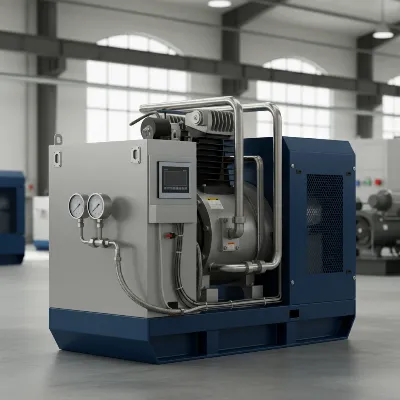 A powerful rotary screw air compressor in an industrial setting, showcasing its compact design and continuous operation capability for high-volume air supply.
Centrifugal Air Compressors
Centrifugal air compressors are dynamic machines reserved for the highest volume industrial needs. They accelerate air using a rotating impeller, converting high velocity into high pressure. These are often multi-stage compressors capable of delivering significant horsepower.
- Advantages: Centrifugal compressors are highly efficient for large-scale operations, produce oil-free air, and require minimal maintenance compared to other types due to fewer wearing parts. They can deliver vast amounts of compressed air.
- Disadvantages: Their complexity and massive output capability mean they have the highest initial investment cost and require a larger installation footprint. They are not suitable for small-scale or intermittent applications.
- Suitable Applications: Large-scale manufacturing, chemical plants, steel manufacturing, power generation facilities, and any industry with extremely high and continuous air demand.
Comparison Table of Air Compressor Types
Choosing the right air compressor depends heavily on your specific needs. This table offers a quick comparison across key criteria to help you decide.
| Feature | Piston (Reciprocating) | Rotary Screw | Centrifugal |
|---|---|---|---|
| Principle | Piston movement in cylinder | Interlocking helical rotors | Rotating impeller accelerates air |
| Applications | Small workshops, intermittent use | Continuous industrial use, high demand | Very large industrial, continuous, high volume |
| Efficiency | Moderate | High | Very High |
| Noise Level | High | Moderate to Low | Low |
| Maintenance | Moderate (more frequent part checks) | Moderate (oil/filter changes) | Low (fewer wearing parts) |
| Durability | Good for intermittent use | Excellent for continuous use | Excellent for large-scale, continuous use |
| Air Quality | Can contain oil (oil-lubricated) | Can be oil-free or oil-lubricated | Typically oil-free |
| Initial Cost | Low | Moderate to High | Very High |
Selecting the appropriate type requires careful consideration of factors such as required airflow, pressure, operational hours, and air quality needs.
Air Compressor Buying Guide
Investing in an air compressor means considering more than just the purchase price. A well-informed decision ensures your equipment meets your operational needs efficiently and cost-effectively for its entire lifespan.
Determining Usage Needs
Before purchasing, precisely define what you’ll use the air compressor for. This will dictate the necessary specifications:
- Power (Horsepower – HP): The HP rating indicates the compressor’s motor strength. Larger, more demanding tools or multiple tools running simultaneously will require higher HP.
- Pressure (Pounds per Square Inch – PSI): Different tools require specific operating pressures. Ensure the compressor’s maximum PSI output meets or exceeds the highest pressure requirement of your most demanding tool. Most pneumatic tools operate around 90 PSI.
- Airflow (Cubic Feet per Minute – CFM): This is arguably the most critical metric. CFM indicates how much air the compressor can deliver at a given pressure. Sum the CFM requirements of all tools you plan to operate simultaneously, then add a 20-30% buffer for safety and future expansion. For instance, a small impact wrench might need 4-5 CFM at 90 PSI, while a sandblaster could require 10-20 CFM or more.
- Oil-Lubricated vs. Oil-Free:
- Oil-lubricated compressors use oil to lubricate internal pump components, offering better durability and a longer lifespan. However, they require oil changes and filtration to prevent oil contamination in the air, which can be an issue for sensitive applications [cite: 3_3, 4_4].
- Oil-free compressors use special coatings or materials that eliminate the need for oil in the compression chamber. These are essential for applications requiring pristine air, such as food processing, medical uses, or delicate electronics manufacturing. They generally require less maintenance in terms of oil changes but may have a shorter pump life and can be noisier [cite: 3_3, 4_4, 5_5].
Budget Considerations
Your budget should account for both the initial purchase price and long-term operating costs. While a cheaper compressor might seem appealing initially, it could lead to higher energy consumption, more frequent maintenance, and expensive repairs down the line.
- Initial Cost: Varies significantly by type, size, and brand. Piston compressors are typically the most affordable, followed by rotary screw, and then centrifugal.
- Operating Costs: This includes energy consumption, consumables (filters, oil), and parts replacement. Highly efficient compressors can lead to significant energy savings over their lifespan. A well-maintained compressor can reduce energy costs by 1% on average [cite: 5_2].
- Quality Parts: Investing in high-quality filters, hoses, and oil specifically designed for your compressor can significantly extend its life and prevent premature wear.
Brand and Supplier
Choosing a reputable brand and a reliable supplier is paramount. Established brands often provide better product quality, more readily available spare parts, and comprehensive warranty and after-sales support.
- Reputable Brands: Look for manufacturers with a proven track record in the air compressor industry.
- Reliable Suppliers: A good supplier offers not just the equipment but also expertise, installation services, and a strong maintenance and repair program. This ensures you have support when you need it and access to genuine parts.
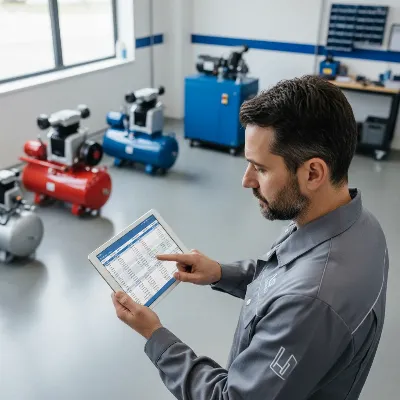 A person reviewing technical specifications on a tablet, with various air compressor types in the background, symbolizing the decision-making process for selection.
Notable Air Compressor Brands
The air compressor market features several leading manufacturers renowned for their quality, innovation, and reliability. While specific brand availability might vary by region, some global leaders consistently stand out.
Atlas Copco is a Swedish multinational industrial company known for its wide range of industrial tools and equipment, including highly efficient and durable air compressors. They are particularly strong in rotary screw and centrifugal compressors for demanding industrial applications, often emphasizing energy efficiency and advanced technology [cite: 1_5].
ELGi Equipments is a global air compressor manufacturer offering a comprehensive range of rotary screw and reciprocating compressors. They focus on delivering reliability, energy efficiency, and low cost of ownership, making them a strong contender across various industrial and commercial sectors [cite: 2_1, 3_4].
Other well-respected brands include Ingersoll Rand, Sullair, and Kaeser Kompressoren, each with their own specializations and product lines catering to different market segments from portable units to large industrial systems. When considering a brand, researching their specific model offerings and local support networks is crucial.
Essential Usage and Maintenance Practices
Consistent and proactive maintenance is the cornerstone of extending your air compressor’s life, ensuring peak performance, and maintaining a safe working environment. Adhering to a routine maintenance schedule can prevent minor issues from escalating into costly breakdowns and safety hazards.
Safety Measures
Safety should always be your top priority when operating or servicing an air compressor. These powerful machines store significant energy and can pose risks if mishandled.
- Read the Manual: Always refer to your specific compressor’s operating instructions and manufacturer’s recommendations. Each model may have unique needs and safety warnings [cite: 1_5, 1_6].
- Personal Protective Equipment (PPE): Wear appropriate PPE, including safety glasses to protect against flying debris, hearing protection for noise, and gloves [cite: 2_6, 3_6, 5_6].
- Work Environment: Ensure the compressor is placed in a well-ventilated area, away from excessive dust, humidity, and extreme temperatures. Good air circulation prevents overheating and moisture damage [cite: 1, 3, 3_4, 4_4]. Keep the area clear of clutter to prevent trip hazards [cite: 2_6].
- Power Down and Depressurize: Always disconnect the power supply and completely depressurize the system before performing any cleaning, inspection, or servicing. Never use liquid or aerosol cleaners directly on electrical components [cite: 3, 1_6].
- Pressure Relief Valve: Never tamper with or adjust the pressure relief valve, as it is calibrated and sealed by the manufacturer to prevent over-pressurization [cite: 1, 1_6].
- Proper Grounding: Ensure all electrical components are properly grounded to prevent electrical hazards [cite: 3_6].
- Do Not Use for Breathing Air: Unless specifically designed and certified for it, do not use compressed air for breathing [cite: 1_6, 3_6].
- Protect Hoses: Avoid kinking or running over air hoses, and use proper safety chains or devices for high-pressure lines to prevent damage or rupture [cite: 4_6].
Routine Maintenance
Following a consistent maintenance schedule, often recommended by the manufacturer, is vital for longevity and efficiency.
- Oil and Filter Changes:
- Oil-Lubricated Compressors: Regularly check the oil level (daily or weekly) and maintain it within the manufacturer’s specified range. Use only the type of oil recommended by the manufacturer (e.g., synthetic hydrocarbon, polyol esters) [cite: 1, 1_4, 1_5, 3]. Change the oil according to the recommended intervals, typically every 2,000–8,000 hours, or every 3 months for food-grade oil [cite: 1_4].
- Air Filters: Inspect and replace air intake filters, oil filters, and inline filters regularly. Clogged filters restrict airflow, reduce efficiency, and force the compressor to work harder, increasing energy consumption. Keep spare filters on hand [cite: 1, 2, 3, 4_4, 1_5, 2_5].
- Draining Moisture: Moisture buildup in the air receiver tank can lead to rust, corrosion, and water contamination in the air system. Regularly drain the condensate from the tank (daily or monthly, or more often in humid climates). Ensure automatic drains are functioning correctly [cite: 1, 2, 1_6, 5_5]. Consider installing a moisture separator or dryer if humidity is a consistent problem [cite: 5_5].
- Leak Detection: Air leaks in hoses, fittings, and connections can significantly reduce efficiency and increase energy consumption. Regularly inspect all components for signs of wear, cracks, or leaks, and tighten or replace them as necessary [cite: 1, 2, 3, 1_5, 5_5].
- Cleaning: Keep the compressor unit, tank, and hoses clean. Wipe down the exterior, and use compressed air or a soft brush to clear dust and debris from cooling fins and air intake vents to ensure optimal airflow and prevent overheating [cite: 3, 5_2].
- Belt Inspection (for belt-driven models): For piston compressors, inspect drive belts, pulleys, and tensioners weekly or monthly. Adjust alignment or tension according to manufacturer specifications and replace worn belts [cite: 4_4].
- Monitoring Sounds and Vibrations: Pay attention to any unusual noises or excessive vibrations, which can indicate loose components, worn bearings, or lack of lubrication. Address these issues promptly to prevent further damage [cite: 2_3, 4_3].
- Preventing Overheating: Ensure adequate ventilation around the compressor and avoid overloading it. Overheating can accelerate oil degradation and damage internal parts. Maintain the room temperature between 50°F and 85°F (10°C and 29°C) if possible [cite: 1, 1_4, 3_3].
- Adhere to Manufacturer’s Schedule: Always follow the specific maintenance schedule provided in your compressor’s manual. This will detail routine tasks like oil changes, filter replacements, and inspections of critical components [cite: 3, 4_3, 5_5].
- Maintenance Log: Keep a detailed maintenance log, documenting each service, replacement part, and inspection result. This helps track service intervals and identify recurring issues [cite: 3, 3_4, 3_5].
> “Regular maintenance is the cornerstone of air compressor efficiency and longevity. By adhering to a routine maintenance schedule, you can detect potential issues early, thus preventing minor problems from escalating into major failures.” – Andrew Koo, Winston Engineering Corporation
Conclusion
Maintaining your air compressor is not merely a task; it’s an investment in its performance, longevity, and safety. By diligently following essential maintenance practices—from regular oil and filter changes to consistent leak detection and adherence to safety protocols—you safeguard your equipment against premature wear and costly breakdowns. A well-maintained air compressor operates more efficiently, consumes less energy, and provides a reliable power source for all your pneumatic needs.
that each air compressor is unique, and consulting your owner’s manual for specific guidelines is always the best practice. Are you ready to optimize your air compressor’s performance and extend its lifespan with a proactive maintenance routine?
Frequently Asked Questions
How often should I drain my air compressor tank?
You should drain the condensate from your air compressor’s receiver tank daily, especially in humid environments, to prevent rust and corrosion. Some manufacturers recommend doing it after each use [cite: 1_6, 5_5].
What happens if I don’t change the oil in my air compressor?
Neglecting oil changes in oil-lubricated compressors can lead to reduced lubrication, increased friction, overheating, and premature wear of internal components, ultimately shortening the compressor’s lifespan and potentially causing costly mechanical failures [cite: 1_4].
Can I use any type of oil in my air compressor?
No, it is crucial to use only the type of oil or lubricant specified by your air compressor’s manufacturer. Using an incorrect oil type can lead to compatibility issues, poor lubrication, reduced efficiency, and damage to the compressor [cite: 1, 1_4].
How do I check for air leaks in my compressor system?
To check for air leaks, listen for hissing sounds around hoses, fittings, and connections while the compressor is pressurized. For more subtle leaks, you can apply a soapy water solution to these areas; bubbles will form where air is escaping [cite: 1, 5_5].
What are the signs of an overheating air compressor?
Signs of an overheating air compressor include the unit feeling excessively hot to the touch, unusual noises, reduced performance, or an automatic shutdown due to high temperature. Common causes include inadequate ventilation, low oil levels, or dirty cooling fins [cite: 1, 3_3].
