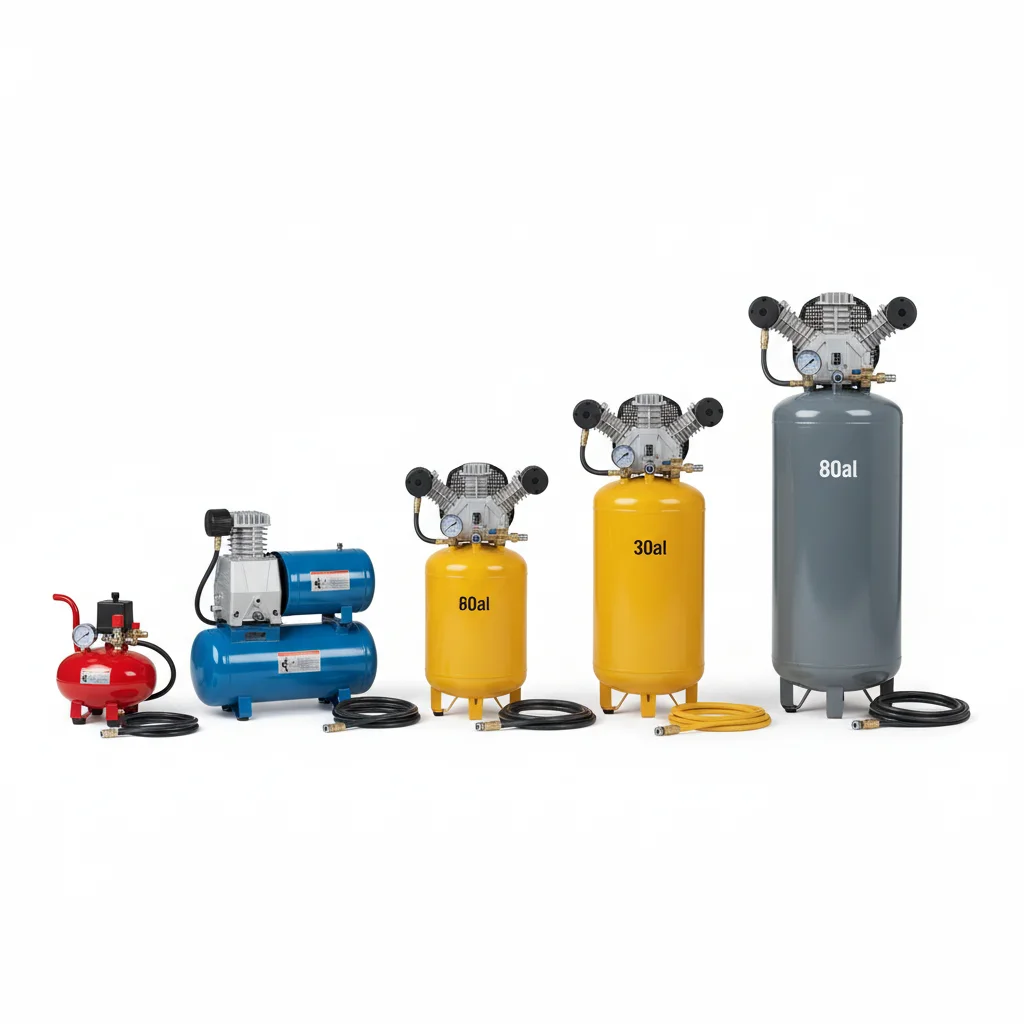
Choosing the right air compressor tank size is crucial for efficient operation and depends entirely on your specific applications. For intermittent, light-duty tasks like inflating tires or using a brad nailer, a smaller tank of 1-6 gallons is often sufficient. However, for continuous, high-demand tools such as impact wrenches or paint sprayers, a larger tank of 20-60 gallons or more will provide the necessary sustained airflow without constant motor cycling.
Understanding CFM and Tank Volume
The relationship between CFM (Cubic Feet per Minute) and tank volume is often misunderstood. While CFM dictates the continuous airflow a compressor can deliver, the tank size acts as a reservoir, storing compressed air to meet peak demands. A larger tank can compensate for a compressor with a lower CFM rating during short bursts of high usage, preventing the motor from running constantly. Conversely, a high CFM compressor with a small tank might still struggle with tools that require sustained airflow.
Consider the CFM requirements of your most demanding tools. For example, a typical framing nailer might need 2.2 CFM at 90 PSI, while an air sander could require 8-12 CFM at 90 PSI. Your tank size should be chosen to support these demands, allowing the compressor to build pressure and then rest, rather than continuously running.
Tank Sizes for Common Applications
Different projects necessitate different tank capacities. For small household tasks, a 1-6 gallon pancake or hot dog style compressor is ideal. These are lightweight, portable, and perfect for inflating sports equipment, cleaning workspaces with an air gun, or powering small finish nailers.
For DIY enthusiasts tackling automotive work, woodworking, or medium-duty construction, a 10-30 gallon tank offers a good balance of portability and sustained power. This range can comfortably run impact wrenches, ratchets, and even some smaller spray guns for short periods. The motor won’t cycle as frequently, leading to a longer lifespan for the compressor.
Professional workshops and industrial settings often require 60-gallon or larger vertical tanks. These are designed for continuous, heavy-duty applications like sandblasting, operating multiple tools simultaneously, or running high-volume paint sprayers. The substantial air reserve ensures consistent pressure and minimizes motor wear.
Factors Influencing Your Tank Size Decision
|
Our Picks for the Best Air Compressor in 2026
As an Amazon Associate I earn from qualifying purchases.
|
||
| Num | Product | Action |
|---|---|---|
| 1 | Craftsman Air Compressors 6 Gallon Portable Pancake Air Compressor,Oil Free Max 150 Psi 1.0HP 2.6 CFM@90PSI Electric Air Compressor Shop Air Compressor, CMXECXA02106410 |

|
| 2 | Tire Inflator Portable Air Compressor, 150PSI Cordless Air Pump for Car Tires with Auto Shut-Off, Portable Tire Pump for Car, Bike, Motorcycle and Balls |
|
| 3 | DEWALT Tire Inflator Portable Air Compressor 20V MAX, Car Air Pump with Automatic Shut Off, LED Light, Tool Only (DCC020IB) |
|
| 4 | Airmoto Tire Inflator Portable Air Compressor - Air Pump for Car Tires with Digital Pressure Gauge, LED Light and Auto Shut-Off Function - Cordless Pump for Car, Motorcycle, Bicycle, Ball |
|
| 5 | ECOMAX Air Compressor 6 Gallon 150 PSI Pancake Portable Oil-free Tank with 10 PCS Accessories Kit |
|
| 6 | Quiet Air Compressor, Only 68dB, 5 Gallon Steel Tank, 2.8CFM @ 90PSI, Oil-Free, Electric Air Compressor Perfect for Woodwork Nailing, Garage, Car, Pneumatic Tool, Includes 11 Accessories |
|
| 7 | AC Compressor for 2000-2027 Chevy Silverado/GMC Sierra/Cadillac Escalade (4.8L/5.3L/6.0L V8) | OE Replaces 15036042, 15707611, CO29002C,78363, 78362 | A/C Compressor & Kit |
|
| 8 | Metabo HPT Pancake Air Compressor, 6-Gallon 165PSI, Portable Air Compressor with 1.0 HP Oil-Free High Efficiency Motor, Lihghtweight, Quick Couplers for Fast Tool Changes, EC711S |
|
| 9 | CRAFTSMAN Air Compressor, 2 Gallon Portable Air Compressor 1/3HP Max 125 PSI Oil-Free Light Weight with 10 PCS Accessory Kit |
|
| 10 | California Air Tools CAT-4710W 1.0 HP Quiet and Oil-Free Air Compressor with Wheels, 4.7 Gallon Steel Tank, 75 dBA Noise Level, Lightweight |
|
- Tool Requirements: Always check the CFM and PSI requirements of your most power-hungry air tools.
- Usage Frequency: If you use air tools intermittently, a smaller tank might suffice. For continuous use, a larger tank is essential.
- Portability Needs: Smaller tanks are inherently more portable. Larger tanks are typically stationary.
- Space Availability: Vertical tanks save floor space but require height. Horizontal tanks need more floor area.
- Budget: Generally, larger tanks come with a higher price tag, but also offer greater versatility.
Optimizing Performance with the Right Tank
Selecting the correct air compressor tank size is not just about having enough air; it’s about optimizing the performance of your tools and the longevity of your compressor. An undersized tank will cause the compressor motor to cycle excessively, leading to premature wear and tear, increased noise, and inconsistent tool performance. An oversized tank, while providing ample air, might be an unnecessary expense and take longer to fill initially, though it will cycle less frequently once full.
Consider the future. If you anticipate expanding your tool collection to include more demanding pneumatic equipment, it’s often wise to invest in a slightly larger tank than your current needs dictate. This foresight can save you from needing to upgrade your entire compressor system down the line.

Good info overall, especially the part about CFM and tank volume. I thought a bigger tank would always mean better, but it really depends on the tool. My only minor complaint is that it didn’t really touch on portable options for job sites, which would have been useful for me. Still, it helped me narrow down my home shop needs.
This was super helpful in figuring out what I needed. I mostly do light-duty tasks like inflating tires and using a brad nailer, so I was leaning towards a smaller tank. The explanation about 1-6 gallons being sufficient for those intermittent jobs was spot on. My new 4-gallon compressor is perfect for my garage.
I was totally confused about air compressor tank sizes before reading this. The breakdown of how tank size acts as a reservoir and helps with sustained airflow for things like paint sprayers was exactly what I needed. I was about to buy something too small, but now I’m confident in getting a 30-gallon tank for my painting projects.
I’ve always struggled with my old compressor constantly cycling when I’m trying to use my impact wrench. This guide really helped me understand why a larger tank is so important for those high-demand tools. I ended up getting a 60-gallon unit, and it’s made a world of difference. No more waiting around for the pressure to build back up!