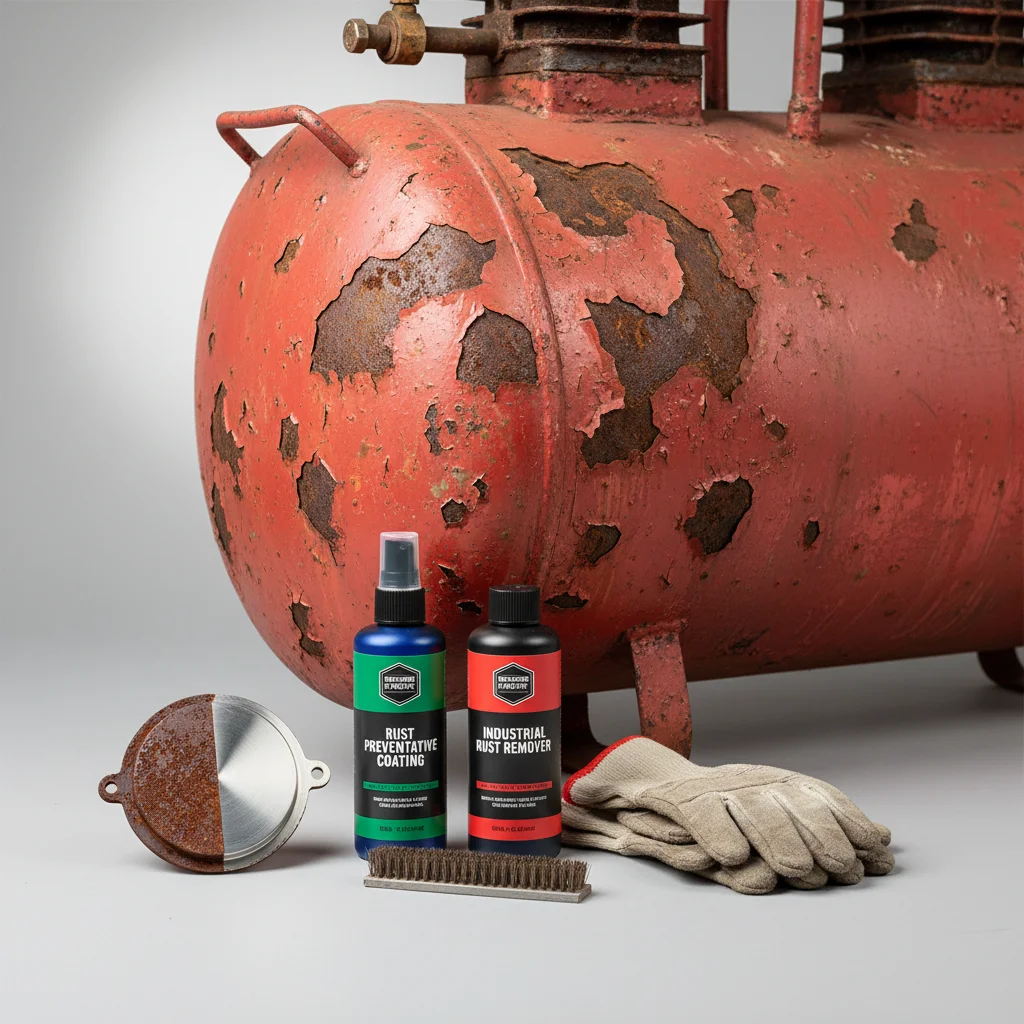
Preventing and treating air compressor tank rust is crucial for the longevity and safety of your equipment. The most effective strategy involves a combination of regular moisture drainage, proper storage, and the application of protective coatings. Addressing rust early can save you from costly repairs or even tank failure.
Understanding Air Compressor Tank Rust
Rust forms when the iron in your compressor tank reacts with oxygen and water. Inside an air compressor tank, condensation is a constant issue due to the compression process, creating an ideal environment for rust to thrive. This internal rust can weaken the tank walls, leading to leaks or, in severe cases, catastrophic rupture. External rust, while less immediately dangerous, can also compromise the tank’s integrity over time.
Preventing Internal Tank Rust
The primary method for preventing internal rust is consistent moisture drainage. You should drain your air compressor tank after every use, or at least daily if used frequently. This removes the accumulated water that accelerates rust formation. Additionally, consider installing an inline air dryer or a refrigerated air dryer to reduce the amount of moisture entering the tank in the first place. Using rust-inhibiting oils in the compressor pump can also offer some protection, though this primarily benefits the pump itself.
- Drain tank daily or after each use.
- Install an inline or refrigerated air dryer.
- Store compressor in a dry, climate-controlled area.
- Regularly inspect the drain valve for proper function.
- Consider internal tank coatings for new units.
Treating Existing Internal Rust
|
Our Picks for the Best Air Compressor in 2026
As an Amazon Associate I earn from qualifying purchases.
|
||
| Num | Product | Action |
|---|---|---|
| 1 | Airmoto Tire Inflator Portable Air Compressor - Air Pump for Car Tires with Digital Pressure Gauge, LED Light and Auto Shut-Off Function - Cordless Pump for Car, Motorcycle, Bicycle, Ball |

|
| 2 | Tire Inflator Portable Air Compressor, 150PSI Cordless Air Pump for Car Tires with Auto Shut-Off, Portable Tire Pump for Car, Bike, Motorcycle and Balls |
|
| 3 | ECOMAX Air Compressor 6 Gallon 150 PSI Pancake Portable Oil-free Tank with 10 PCS Accessories Kit |
|
| 4 | CRAFTSMAN Air Compressor, 2 Gallon Portable Air Compressor 1/3HP Max 125 PSI Oil-Free Light Weight with 10 PCS Accessory Kit |
|
| 5 | AC Compressor for 2000-2027 Chevy Silverado/GMC Sierra/Cadillac Escalade (4.8L/5.3L/6.0L V8) | OE Replaces 15036042, 15707611, CO29002C,78363, 78362 | A/C Compressor & Kit |
|
| 6 | Metabo HPT Pancake Air Compressor, 6-Gallon 165PSI, Portable Air Compressor with 1.0 HP Oil-Free High Efficiency Motor, Lihghtweight, Quick Couplers for Fast Tool Changes, EC711S |
|
| 7 | DEWALT Tire Inflator Portable Air Compressor 20V MAX, Car Air Pump with Automatic Shut Off, LED Light, Tool Only (DCC020IB) |
|
| 8 | Quiet Air Compressor, Only 68dB, 5 Gallon Steel Tank, 2.8CFM @ 90PSI, Oil-Free, Electric Air Compressor Perfect for Woodwork Nailing, Garage, Car, Pneumatic Tool, Includes 11 Accessories |
|
| 9 | Craftsman Air Compressors 6 Gallon Portable Pancake Air Compressor,Oil Free Max 150 Psi 1.0HP 2.6 CFM@90PSI Electric Air Compressor Shop Air Compressor, CMXECXA02106410 |
|
| 10 | California Air Tools CAT-4710W 1.0 HP Quiet and Oil-Free Air Compressor with Wheels, 4.7 Gallon Steel Tank, 75 dBA Noise Level, Lightweight |
|
If you suspect internal rust, a thorough inspection is necessary. For minor surface rust, some users attempt to flush the tank with a rust-removing solution, though this can be risky and is often not recommended by manufacturers. A safer approach for light rust might involve using a rust converter product designed for internal metal surfaces, followed by a protective coating. However, if the rust is extensive or has caused pitting, it’s often safer to replace the tank or the entire compressor, as structural integrity may be compromised. Always consult the manufacturer’s guidelines before attempting any internal rust treatment.
Preventing and Treating External Rust
External rust is typically easier to manage. Keep your compressor in a dry environment, away from direct rain or excessive humidity. Regularly clean the exterior of the tank to remove dirt and debris that can trap moisture. For existing external rust, sand the affected areas down to bare metal, then apply a rust-inhibiting primer followed by a durable, rust-resistant paint. Ensure the paint is suitable for metal surfaces and can withstand the operating conditions of the compressor.
When to Consider Tank Replacement
Knowing when to replace your air compressor tank is critical for safety. If you observe significant pitting, bulging, or deep rust that has compromised the tank’s wall thickness, replacement is the safest option. Any signs of air leaks from the tank itself (not just fittings) are also a strong indicator that the tank’s integrity is compromised. Never attempt to weld or patch a rusted air compressor tank, as this can lead to dangerous failures under pressure. Regular inspections, especially of older units, can help you identify these issues before they become critical.

Great tips here. I had some external rust on my portable unit and wasn’t sure the best way to tackle it without damaging the paint. The advice on protective coatings was really helpful. I applied a rust-inhibiting primer and it looks much better now. Wish I’d found this before the rust started, though!
Good info on preventing internal rust, but I was hoping for a bit more detail on specific products for treating existing internal rust. It mentions addressing rust early, which is true, but what if you’re past that point? Still, the explanation of how condensation creates the ideal environment for rust was very clear.
This guide was a lifesaver! I’ve always been pretty good about draining my tank, but I never really thought about how crucial consistent moisture drainage is. After reading this, I’m definitely going to be more diligent. My old compressor lasted forever, and I want this new one to do the same.
I’ve been worried about my older compressor tank and the potential for catastrophic rupture. This really broke down why it happens and what to do. The emphasis on proper storage is something I’m going to implement right away. Thanks for making it so easy to understand!