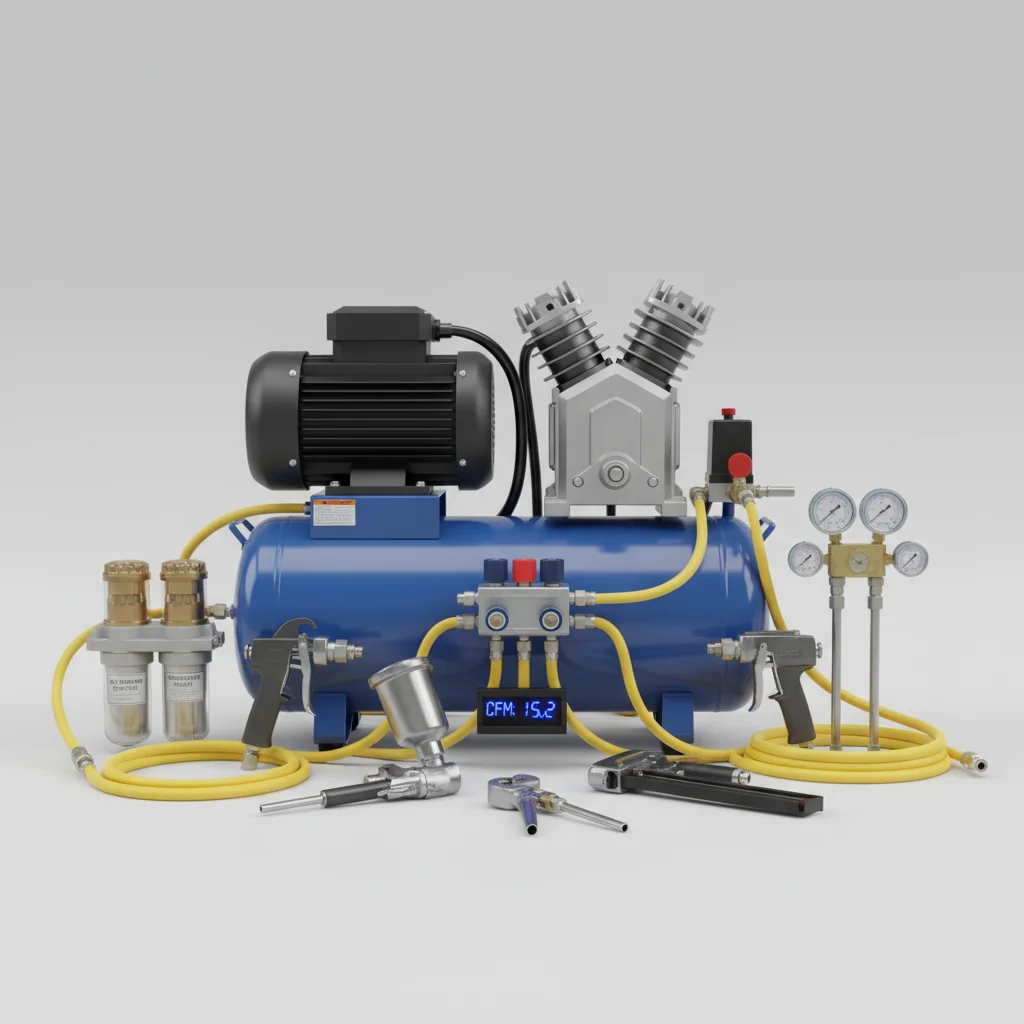
Understanding air compressor CFM requirements is crucial for selecting the right unit for your tools and projects. CFM, or cubic feet per minute, directly indicates the volume of air an compressor can deliver at a specific pressure (PSI). For most common DIY and home garage tasks, you’ll typically need an air compressor that can deliver between 3-6 CFM at 90 PSI. This range covers popular tools like nail guns, impact wrenches, and paint sprayers, ensuring they operate efficiently without interruption.
What is CFM and Why Does it Matter?
CFM is a measure of airflow, representing how much air an air compressor can produce per minute. It’s a critical specification because every air tool has a specific CFM requirement to function correctly. If your compressor’s CFM output is too low for a particular tool, the tool will underperform, cycle frequently, or even stop working altogether. Conversely, a compressor with a much higher CFM than needed might be an unnecessary expense and take up more space than required. For complete air compressor library on this site.
The CFM rating is often provided at a specific PSI (pounds per square inch), such as 5 CFM @ 90 PSI. Always match the tool’s required CFM at its operating pressure to the compressor’s output. Ignoring this can lead to frustration and inefficient work.
Calculating Your Tool’s CFM Needs
To accurately determine your air compressor CFM requirements, you need to identify the CFM demands of your most air-intensive tools. Most air tools list their CFM requirements in their specifications, usually at 90 PSI. If you plan to use multiple tools simultaneously, you’ll need to sum their individual CFM requirements and add a buffer of about 20-30% to account for potential leaks and efficiency losses. For example, if you have a sander requiring 10 CFM and an impact wrench needing 5 CFM, you’d look for a compressor capable of at least 18-20 CFM at 90 PSI to run both effectively.
- Check the manufacturer’s specifications for each air tool.
- Identify the CFM at the recommended operating PSI (usually 90 PSI).
- Add a 20-30% buffer for simultaneous tool use or future expansion.
- Consider peak usage scenarios, not just average use.
- Factor in the length and diameter of your air hoses, as longer, narrower hoses can reduce effective CFM.
Common CFM Requirements for Popular Air Tools
Different air tools have vastly different CFM demands. A small brad nailer might only need 0.5-2 CFM, while a heavy-duty sandblaster could require 15-25 CFM or more. For general home use, a 3-6 CFM compressor at 90 PSI is sufficient for most tasks like inflating tires, operating finish nailers, and light painting. For automotive work or more demanding projects, you’ll likely need a compressor in the 8-15 CFM range. Always prioritize the tool with the highest continuous CFM requirement when sizing your compressor.
For example, an air ratchet typically needs 4-5 CFM, while a die grinder can demand 6-8 CFM. A spray gun for automotive painting might require 10-15 CFM for consistent, high-quality finishes. Understanding these variations is key to making an informed purchase.
Choosing the Right Compressor Based on CFM
Once you’ve calculated your total CFM needs, you can confidently select an air compressor. Look for a compressor whose
