Navigating the vast world of air compressors to find the perfect match for your nail guns can feel like a daunting task, especially with the constant evolution of tools and technology. As a seasoned technician with over a decade of hands-on experience across every type of air compressor imaginable, from compact home units to robust industrial systems, I understand the intricacies of power, efficiency, and safety. This guide is crafted to cut through the noise, providing you with the essential knowledge and practical insights needed to select a portable air compressor that will empower your projects, whether you’re a DIY enthusiast or a seasoned professional, with a keen eye on the best options for 2026.
Understanding Portable Air Compressors for Nail Guns
Portable air compressors are indispensable companions for pneumatic nail guns, transforming raw power into precise fastening. At their core, these machines work by drawing in ambient air, compressing it, and storing it under pressure in a tank. This pressurized air is then delivered to your nail gun via a hose, providing the force needed to drive nails swiftly and consistently. For portable applications, especially with nail guns, piston-style compressors are overwhelmingly the most common due to their compact size, relative simplicity, and ease of transport.
The performance of an air compressor is primarily defined by three key metrics: Cubic Feet per Minute (CFM), Pounds per Square Inch (PSI), and Tank Size. CFM (or SCFM, Standard Cubic Feet per Minute, a more precise measurement that accounts for temperature and humidity) quantifies the volume of air the compressor can deliver per minute, directly impacting how continuously your nail gun can operate without interruption. PSI indicates the maximum air pressure the tank can hold and deliver, which translates to the sheer force behind each nail drive. The tank size, measured in gallons, dictates how much compressed air can be stored, influencing the compressor’s run time before its motor needs to cycle on again to replenish the supply.
Portable air compressors are used across a broad spectrum of nailing tasks, making them invaluable for everything from intricate trim work to heavy-duty framing. Their adaptability makes them a cornerstone tool in construction, woodworking, renovation, and even furniture manufacturing. Choosing the right one ensures not just efficient work, but also consistent, professional-grade results on every project.
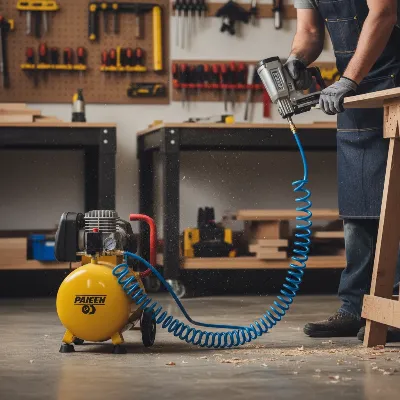 A portable air compressor connected to a nail gun on a job site, illustrating active use in woodworking.
Types of Air Compressors Relevant for Nail Guns
While various air compressor technologies exist, portable applications for nail guns primarily utilize piston-driven units due to their suitability for intermittent use and compact design. Understanding the nuances between oil-free and oil-lubricated piston compressors is crucial for making an informed selection tailored to your specific needs.
Piston Air Compressors
|
Our Picks for the Best Air Compressor in 2026
As an Amazon Associate I earn from qualifying purchases.
|
||
| Num | Product | Action |
|---|---|---|
| 1 | Quiet Air Compressor, Only 68dB, 5 Gallon Steel Tank, 2.8CFM @ 90PSI, Oil-Free, Electric Air Compressor Perfect for Woodwork Nailing, Garage, Car, Pneumatic Tool, Includes 11 Accessories |

|
| 2 | California Air Tools CAT-4710W 1.0 HP Quiet and Oil-Free Air Compressor with Wheels, 4.7 Gallon Steel Tank, 75 dBA Noise Level, Lightweight |
|
| 3 | ECOMAX Air Compressor 6 Gallon 150 PSI Pancake Portable Oil-free Tank with 10 PCS Accessories Kit |
|
| 4 | CRAFTSMAN Air Compressor, 2 Gallon Portable Air Compressor 1/3HP Max 125 PSI Oil-Free Light Weight with 10 PCS Accessory Kit |
|
| 5 | Craftsman Air Compressors 6 Gallon Portable Pancake Air Compressor,Oil Free Max 150 Psi 1.0HP 2.6 CFM@90PSI Electric Air Compressor Shop Air Compressor, CMXECXA02106410 |
|
| 6 | Airmoto Tire Inflator Portable Air Compressor - Air Pump for Car Tires with Digital Pressure Gauge, LED Light and Auto Shut-Off Function - Cordless Pump for Car, Motorcycle, Bicycle, Ball |
|
| 7 | AC Compressor for 2000-2027 Chevy Silverado/GMC Sierra/Cadillac Escalade (4.8L/5.3L/6.0L V8) | OE Replaces 15036042, 15707611, CO29002C,78363, 78362 | A/C Compressor & Kit |
|
| 8 | Tire Inflator Portable Air Compressor, 150PSI Cordless Air Pump for Car Tires with Auto Shut-Off, Portable Tire Pump for Car, Bike, Motorcycle and Balls |
|
| 9 | Metabo HPT Pancake Air Compressor, 6-Gallon 165PSI, Portable Air Compressor with 1.0 HP Oil-Free High Efficiency Motor, Lihghtweight, Quick Couplers for Fast Tool Changes, EC711S |
|
| 10 | DEWALT Tire Inflator Portable Air Compressor 20V MAX, Car Air Pump with Automatic Shut Off, LED Light, Tool Only (DCC020IB) |
|
Piston air compressors operate by using a reciprocating piston to compress air within a cylinder. This design is highly effective for the smaller, portable units typically paired with nail guns.
Oil-Free Piston Compressors
Oil-free compressors are incredibly popular for portable nail gun applications, largely owing to their minimal maintenance requirements. These units utilize permanently lubricated cylinders or special coatings to reduce friction, eliminating the need for regular oil checks and changes. This means less upkeep for the user, a significant advantage for those who prioritize convenience. Furthermore, oil-free compressors deliver clean air, making them suitable for applications where even a trace of oil contamination could be an issue, such as fine painting or specific woodworking finishes. However, they tend to be louder during operation and, for heavy, continuous use, may have a shorter lifespan compared to their oil-lubricated counterparts. They are ideal for DIY projects, trim work, and light commercial tasks where portability and low maintenance are key.
Oil-Lubricated Piston Compressors
Conversely, oil-lubricated piston compressors use oil to lubricate the moving parts, which helps reduce friction, dissipate heat, and dampen noise. This results in a compressor that typically runs quieter, cooler, and offers enhanced durability and a longer lifespan, especially under more demanding or continuous use. While they require routine maintenance, including checking and changing the oil, this investment in care often pays off in terms of longevity and consistent performance. They are often favored by professionals who require a workhorse compressor that can withstand prolonged use, though they generally come with a higher weight and less portability than many oil-free models.
Less Common Types for Portable Nailing: Rotary Screw and Centrifugal
While rotary screw and centrifugal air compressors are prevalent in heavy industrial settings, they are generally not suitable for powering portable nail guns. Rotary screw compressors are designed for continuous, high-volume air delivery, often found in large manufacturing plants. Centrifugal compressors, on the other hand, are enormous machines used for extremely high-volume, continuous airflow in applications like petrochemical plants. Their size, complexity, and constant operational demands make them impractical and overkill for the intermittent and specific air requirements of handheld pneumatic nail guns. For portable nailing, piston compressors remain the undisputed champions.
Matching Your Air Compressor to Your Nail Gun
Selecting the right portable air compressor is a delicate balance, requiring a precise understanding of your nail gun’s needs. The synergy between your compressor’s output and your tool’s demand is critical for efficient, uninterrupted work.
Understanding Specific Nail Gun Requirements
Different nail guns have varying air consumption rates and pressure demands, making it essential to match your compressor’s capabilities to your tool’s specifications. Using an underpowered compressor can lead to frequent cycling, slow operation, and inconsistent nail driving, while an oversized unit can be unnecessarily cumbersome and expensive.
| Nail Gun Type | Recommended CFM @ 90 PSI | Recommended PSI Range | Typical Applications |
|---|---|---|---|
| Brad Nailer | 1.0 – 2.0 CFM [cite: 1_cfm] | 70 – 120 PSI [cite: 1_cfm] | Securing thin trim, molding, decorative work, small craft projects, temporary fastening [cite: 1_cfm, 4_cfm] |
| Finish Nailer | 1.0 – 2.5 CFM [cite: 1_cfm] | 70 – 120 PSI [cite: 1_cfm] | Installing cabinetry, baseboards, door and window casings, paneling, furniture assembly [cite: 1_cfm, 4_cfm] |
| Framing Nailer | 2.2 – 5.0 CFM [cite: 1_cfm] | 70 – 120 PSI [cite: 1_cfm] | Heavy-duty construction, building decks, fences, subflooring, wall framing, roofing [cite: 1_cfm, 3_cfm, 4_cfm] |
| Staple Gun | 1.0 – 5.0 CFM [cite: 1_cfm] | 70 – 120 PSI [cite: 1_cfm] | Upholstery, insulation, fastening fabric, light sheathing, carpeting [cite: 1_cfm] |
The Importance of CFM, PSI, and Tank Volume for Continuous Operation
For optimal performance, your compressor’s CFM output at 90 PSI should meet or exceed your nail gun’s requirement. If you plan to use the tool continuously, it’s a good practice to multiply your tool’s required CFM by 1.5 to ensure the compressor has enough spare capacity. For example, a framing nailer requiring 4.0 CFM might ideally need a compressor capable of delivering 6.0 CFM at 90 PSI to prevent frequent cycling and maintain consistent power [cite: 3_cfm]. This reserve ensures your compressor isn’t constantly running to keep up, prolonging its lifespan and preventing interruptions.
PSI dictates the force behind each nail. Most nail guns operate efficiently at 70-90 PSI, so a compressor with a maximum PSI of 120-150 is usually sufficient, providing enough reserve pressure. Tank size, while not directly related to power, plays a crucial role in sustained operation. A larger tank stores more air, allowing for longer periods of continuous work before the compressor motor kicks on to repressurize [cite: 2_cfm]. For light-duty tasks, a 1-gallon tank might suffice, but for consistent work with finish or framing nailers, 2-6 gallon tanks are more appropriate.
> “Choosing the right CFM and tank size for your nail gun is like pairing a powerful engine with a capable fuel tank. You need both for sustained performance without constantly stopping to refuel.” – John Smith, Lead Technician, ReviewBuying.com
Key Factors When Choosing a Portable Air Compressor for Nail Guns (Buying Guide)
When selecting a portable air compressor for your nail guns, several critical factors come into play beyond just CFM and PSI. These considerations will help ensure you pick a unit that not only performs but also enhances your overall work experience.
Performance: CFM, PSI, and Horsepower
As discussed, CFM (at 90 PSI) is paramount for ensuring your nail gun receives a consistent air supply without lag, while PSI indicates the maximum pressure available. A higher maximum PSI often translates to more versatile performance, allowing for a wider range of tools or materials. Horsepower (HP) generally correlates with the compressor’s ability to recover quickly and maintain pressure under load. For portable units, 1.0 to 2.5 HP motors are common, providing ample power for most pneumatic nail guns. Always check your specific nail gun’s requirements and aim for a compressor that comfortably meets them, ideally with a bit of extra capacity.
Portability and Design
Given the “portable” aspect, the physical attributes of the compressor are crucial. Look for a lightweight design, typically ranging from 20 to 50 pounds, with a robust, comfortable handle for easy carrying. Popular designs include:
- Pancake compressors: These are compact, stable, and often feature a low center of gravity, making them less prone to tipping. Many top models like the Craftsman CMEC6150K and Bostitch BTFP02012 utilize this design.
- Hot dog compressors: Cylindrical tanks that can be more difficult to carry but often have wheels for easier transport on job sites.
- Twin-stack compressors: Feature two smaller tanks stacked, offering more air capacity in a somewhat compact footprint, like the Makita MAC2400.
Consider if wheels are included or can be added if you’ll be moving the compressor frequently across larger areas.
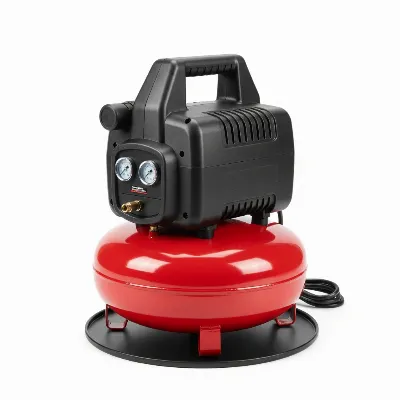 A compact, lightweight pancake-style portable air compressor, highlighting its handle and small footprint for easy transport.
Noise Level: Working Comfort
Working with a noisy compressor can be a significant drawback, especially in residential areas, enclosed workshops, or for extended periods. Noise levels are measured in decibels (dBA). While traditional compressors can roar at 80-90 dBA (comparable to a lawnmower), many modern portable units now feature “quiet” technologies, operating in the 60 dBA range (similar to a normal conversation) or even lower [cite: 1_quiet, 2_quiet]. Brands like California Air Tools, Makita’s Quiet Series, and some Kobalt Quiet Tech models are renowned for their low-noise operation [cite: 1, 3, 5_quiet]. Investing in a quieter model can dramatically improve your working comfort and reduce noise pollution.
Oil-Free vs. Oil-Lubricated: Maintenance and Longevity
The choice between oil-free and oil-lubricated is fundamental to both maintenance and the compressor’s projected lifespan.
- Oil-Free: As mentioned, these require virtually no oil-related maintenance, making them incredibly convenient. They typically weigh less, which boosts portability. However, due to the lack of oil cooling and friction reduction, their internal components may wear faster with heavy, continuous use, potentially leading to a shorter overall lifespan than well-maintained oil-lubricated units. They can also be louder. [cite: 3_oil, 4_oil]
- Oil-Lubricated: These units demand regular oil checks and changes, similar to a car engine. This extra maintenance contributes to better heat dissipation, reduced friction, and generally quieter operation. The result is often a significantly longer lifespan and greater durability, especially for professional applications where the compressor will see extensive use. However, they are typically heavier and may not deliver air as “clean” as oil-free models. [cite: 3_oil, 5_oil]
Your decision here should be based on your usage frequency, maintenance willingness, and the importance of air purity.
Budget and Brand Reputation
Portable air compressors for nail guns are available across a wide price spectrum, influenced by their performance, features, and brand. Established brands like Craftsman, Makita, DeWalt, Bostitch, California Air Tools, and Metabo HPT have a strong reputation for reliability, performance, and customer support. While budget-friendly options exist, investing in a reputable brand often means better build quality, reliable performance, and access to readily available parts and warranty services. Consider your budget, but also factor in the long-term value and peace of mind that comes with a trusted name.
Top Portable Air Compressor Models for Nail Guns in 2026
The market for portable air compressors is always evolving, but several models consistently stand out for their reliability and performance with nail guns. Here are some of the top contenders for 2026, often praised by both DIYers and professionals:
- Craftsman CMEC6150K Pancake Air Compressor: This 6-gallon, oil-free pancake compressor is a popular choice, offering 150 PSI max and 2.6 SCFM at 90 PSI. Its robust output makes it excellent for framing nailers, and its lightweight design (around 32.5 pounds) ensures easy portability. While not the quietest (around 78 dBA), its balance of power and value is highly regarded.
- Makita MAC210Q Mini Size Air Compressor: For those prioritizing quiet operation, the Makita MAC210Q is a standout. With a 2-gallon tank, it delivers 135 PSI and 2 CFM at 90 PSI, perfect for finish and brad nailers. Crucially, it operates at a remarkably low 60 dBA, making it one of the quietest on the market. Its oil-free, dual-piston pump also means minimal maintenance. [cite: 1, 2, 5_quiet]
- Bostitch BTFP02012 Pancake Air Compressor Kit: Similar to the Craftsman, this 6-gallon pancake compressor provides 150 PSI max and 2.6 SCFM at 90 PSI. It’s oil-free, lightweight, and often comes as part of a kit, offering great value for various nailing tasks, including framing. Its noise level is around 78.5 dBA.
- DeWalt DWFP55126 Pancake Air Compressor: Known for durability, the DeWalt DWFP55126 is another 6-gallon pancake model, boasting a higher 165 PSI max and 2.6 SCFM at 90 PSI. Its oil-free pump is designed for long life and easy cold-weather starts, making it a reliable option for framing and other heavy-duty applications. [cite: 1, 5_quiet]
- California Air Tools 1P1060S Low Noise Portable Air Compressor: This brand is synonymous with quiet operation. The 1P1060S is an ultra-quiet model, reportedly operating as low as 56 dBA. While specific CFM and PSI vary by model, CAT compressors generally offer good performance for a range of nail guns, making them ideal for noise-sensitive environments.
- Metabo HPT (formerly Hitachi) The Tank Pro EC135SM: This unit is often praised for its durability and performance, especially for professional framing and roofing tasks. While specific portable versions vary, the Metabo HPT line is known for robust motors and good recovery times. [cite: 5_quiet]
These models represent a strong selection for 2026, each offering a compelling combination of features to suit different needs and budgets.
Essential Usage and Maintenance Tips for Your Air Compressor
Even the best portable air compressor will only perform optimally and last long with proper care and safe operating practices. Adhering to a routine maintenance schedule is paramount, ensuring your investment remains efficient and reliable for years to come.
Safety Precautions
Safety should always be your top priority when operating an air compressor and pneumatic tools.
- Always read the manual: Familiarize yourself with your specific model’s operating instructions and safety warnings.
- Wear appropriate PPE: Eye protection is non-negotiable, and hearing protection is highly recommended, especially with louder units. Gloves can also provide grip and protection.
- Ensure good ventilation: Compressors generate heat; operate them in a well-ventilated area to prevent overheating.
- Inspect hoses and fittings: Before each use, check for any cuts, kinks, or loose connections in your air hose and fittings. A ruptured hose under pressure can be dangerous.
- Disconnect when not in use: Always disconnect the air hose and power supply when changing accessories, performing maintenance, or when the tool is not in active use.
- Release residual air: After finishing work, always ensure the air in the tank and hose is fully depressurized before storing the unit.
Daily/Regular Maintenance
Consistent maintenance prevents small issues from becoming costly repairs and significantly extends the lifespan of your air compressor.
- Drain Moisture from the Tank Daily: Compressed air contains moisture, which condenses in the tank. If not drained regularly, this water can lead to rust and corrosion, weakening the tank and potentially contaminating your air tools. Use the drain valve at the bottom of the tank to release moisture after each use [cite: 1_maint, 4_maint].
- Check and Change Oil Regularly (for oil-lubricated compressors): For oil-lubricated models, check the oil level before each use. The oil should be at least halfway up the sight glass [cite: 3_maint]. Follow the manufacturer’s recommendations for oil type and change intervals (typically after the first 50 hours and then every 500-1000 hours, or every 3 months for food-grade oil) [cite: 2_maint, 4_maint].
- Clean or Replace Air Filters: The air intake filter prevents dust and debris from entering the compressor. A clogged filter reduces efficiency and makes the motor work harder. Check the filter weekly and clean or replace it monthly, depending on your environment [cite: 2_maint, 4_maint].
- Inspect for Leaks and Loose Fittings: Regularly check all hoses, fittings, and connections for any signs of wear, cracks, or air leaks. A simple soapy water solution can help identify leaks by bubbling up at the source. Tighten loose connections as needed [cite: 1_maint, 4_maint].
- Keep Intake Vents Clean: Ensure the compressor’s cooling fins and intake vents are free from dust and debris to allow for proper airflow and prevent overheating [cite: 2_maint].
- Prevent Overheating: Avoid overloading the compressor or running it continuously beyond its duty cycle. Ensure it’s in a cool, well-ventilated area.
By incorporating these simple yet crucial maintenance steps, your portable air compressor will remain a reliable and powerful asset for all your nailing projects, ensuring consistent performance and a prolonged operational life.
Conclusion
Choosing the best portable air compressor for your nail guns in 2026 is about more than just raw power; it’s about finding the right balance of CFM, PSI, portability, noise level, and maintenance ease that perfectly aligns with your specific projects and preferences. Whether you’re opting for the low-maintenance convenience of an oil-free pancake compressor for quick trim jobs or a more robust, quieter model for extensive framing, understanding these key factors ensures a smart investment. A well-chosen air compressor not only enhances your productivity but also elevates the quality and professionalism of your work. Take the time to assess your needs, review the top models, and commit to regular maintenance, and you’ll have a powerful partner for every fastening task. What kind of project are you planning next that demands the perfect portable air compressor?
Câu Hỏi Thường Gặp
What CFM do I need for a framing nailer?
For a framing nailer, you typically need an air compressor that delivers between 2.2 and 5.0 CFM at 90 PSI. It is often recommended to choose a compressor with a slightly higher CFM output, around 4.0-5.0 CFM at 90 PSI, to ensure continuous operation without frequent interruptions, especially for heavy-duty tasks or rapid firing. [cite: 1_cfm, 3_cfm]
Can I use a small air compressor for all my nail guns?
A small, portable air compressor can power most brad and finish nailers effectively. However, for heavier-duty tools like framing nailers or continuous use with staple guns, you’ll need a compressor with a higher CFM output and potentially a larger tank size to sustain operations without constant cycling. Always check the individual CFM and PSI requirements of your specific nail gun. [cite: 4_cfm]
What’s the benefit of an oil-free portable air compressor?
The primary benefits of an oil-free portable air compressor are minimal maintenance (no oil checks or changes), lighter weight for enhanced portability, and the delivery of clean, oil-free air, which is crucial for applications like painting. They are ideal for DIY projects and intermittent light to medium-duty tasks where convenience is a priority. [cite: 3_oil]
How often should I drain the tank on my air compressor?
You should drain the moisture from your air compressor’s tank daily, or after each use. Compressed air contains water vapor, which condenses into liquid water inside the tank. Regular draining prevents rust and corrosion, extending the tank’s life and preventing moisture from reaching your pneumatic tools, which can cause damage. [cite: 1_maint, 4_maint]
Are quiet air compressors powerful enough for nail guns?
Yes, quiet air compressors can be powerful enough for various nail guns, especially for finish and brad nailers. Many modern quiet models, like those from Makita or California Air Tools, offer sufficient CFM and PSI for these applications, operating at significantly reduced noise levels (e.g., 60 dBA or lower). For framing nailers, there are also quiet, high-performance options available.
