For anyone venturing off-road, maintaining optimal tire pressure is not just about performance, it’s about safety and protecting your investment. A reliable portable air compressor is an indispensable tool, transforming arduous roadside tasks into manageable pit stops. Among the myriad options available, the Viair 400P Portable Air Compressor frequently emerges as a top contender, celebrated for its robust construction and dependable performance. This article delves into the critical aspects of air compressor technology, specifically examining the Viair 400P’s quality, durability, and practical utility to help you ascertain if it’s the right choice for your demanding needs.
Overview of Air Compressors
Air compressors are mechanical devices that convert power, typically from an electric motor, diesel or gasoline engine, into potential energy stored in pressurized air. This process involves drawing in ambient air, reducing its volume, and increasing its pressure, which is then stored in a tank or delivered directly for various applications. The fundamental principle revolves around positive displacement, where a specific volume of air is trapped and then compressed.
Commonly, air compressors are classified based on their operating mechanism. The primary types include piston-driven, rotary screw, and centrifugal compressors, each suited for different scales and types of applications. From powering pneumatic tools in a garage to running heavy machinery in industrial settings, air compressors are versatile workhorses. They are essential for inflating tires, operating paint sprayers, driving nail guns, and even in complex manufacturing processes where a consistent supply of pressurized air is crucial.
Classification of Air Compressors
Understanding the distinct types of air compressors is key to appreciating their varied applications and performance characteristics. Each design offers unique advantages and disadvantages, catering to specific user requirements.
Piston Air Compressors
Piston air compressors, also known as reciprocating compressors, utilize pistons driven by a crankshaft to compress air within a cylinder. They are the most common type for smaller-scale applications.
- Advantages: Piston compressors are generally affordable, easy to maintain, and available in various sizes from small portable units to larger industrial models. They are effective for applications requiring intermittent air flow and high pressures.
- Disadvantages: They tend to be noisier, produce pulsating air flow, and their moving parts can wear down over time, requiring more frequent maintenance than some other types. Their duty cycle can also be a limitation for continuous, heavy-duty use.
- Suitable Applications: Ideal for DIY tasks, automotive workshops, home garages, and portable applications like inflating vehicle tires or powering small pneumatic tools.
|
Our Picks for the Best Air Compressor in 2026
As an Amazon Associate I earn from qualifying purchases.
|
||
| Num | Product | Action |
|---|---|---|
| 1 | ECOMAX Air Compressor 6 Gallon 150 PSI Pancake Portable Oil-free Tank with 10 PCS Accessories Kit |

|
| 2 | Airmoto Tire Inflator Portable Air Compressor - Air Pump for Car Tires with Digital Pressure Gauge, LED Light and Auto Shut-Off Function - Cordless Pump for Car, Motorcycle, Bicycle, Ball |
|
| 3 | CRAFTSMAN Air Compressor, 2 Gallon Portable Air Compressor 1/3HP Max 125 PSI Oil-Free Light Weight with 10 PCS Accessory Kit |
|
| 4 | Tire Inflator Portable Air Compressor, 150PSI Cordless Air Pump for Car Tires with Auto Shut-Off, Portable Tire Pump for Car, Bike, Motorcycle and Balls |
|
| 5 | California Air Tools CAT-4710W 1.0 HP Quiet and Oil-Free Air Compressor with Wheels, 4.7 Gallon Steel Tank, 75 dBA Noise Level, Lightweight |
|
| 6 | AC Compressor for 2000-2027 Chevy Silverado/GMC Sierra/Cadillac Escalade (4.8L/5.3L/6.0L V8) | OE Replaces 15036042, 15707611, CO29002C,78363, 78362 | A/C Compressor & Kit |
|
| 7 | DEWALT Tire Inflator Portable Air Compressor 20V MAX, Car Air Pump with Automatic Shut Off, LED Light, Tool Only (DCC020IB) |
|
| 8 | Quiet Air Compressor, Only 68dB, 5 Gallon Steel Tank, 2.8CFM @ 90PSI, Oil-Free, Electric Air Compressor Perfect for Woodwork Nailing, Garage, Car, Pneumatic Tool, Includes 11 Accessories |
|
| 9 | Metabo HPT Pancake Air Compressor, 6-Gallon 165PSI, Portable Air Compressor with 1.0 HP Oil-Free High Efficiency Motor, Lihghtweight, Quick Couplers for Fast Tool Changes, EC711S |
|
| 10 | Craftsman Air Compressors 6 Gallon Portable Pancake Air Compressor,Oil Free Max 150 Psi 1.0HP 2.6 CFM@90PSI Electric Air Compressor Shop Air Compressor, CMXECXA02106410 |
|
Rotary Screw Air Compressors
Rotary screw compressors operate by trapping air between two meshing helical rotors (screws) that rotate, progressively reducing the volume and thus compressing the air.
- Advantages: These compressors offer a continuous, pulsation-free air supply, are significantly quieter than piston types, and are designed for continuous, heavy-duty operation. They are highly efficient for sustained workloads.
- Disadvantages: Rotary screw compressors typically come with a higher initial cost and are more complex, which can lead to more expensive maintenance if specialized parts or technicians are needed.
- Suitable Applications: Widely used in industrial manufacturing, large automotive repair shops, and applications where a constant, high-volume air supply is critical, such as production lines.
Centrifugal Air Compressors
Centrifugal compressors are dynamic compressors that use an impeller to accelerate air, then decelerate it in a diffuser to convert kinetic energy into pressure.
- Advantages: They are capable of producing extremely high volumes of compressed air, are very efficient for large-scale operations, and are generally oil-free, which is crucial for certain industrial processes. They have fewer moving parts, contributing to high reliability.
- Disadvantages: Centrifugal compressors have the highest initial cost and are not suitable for low-flow applications. Their efficiency is highly dependent on maintaining consistent operating conditions.
- Suitable Applications: Primarily found in very large industrial settings like chemical plants, petrochemical facilities, and other heavy manufacturing industries requiring massive volumes of compressed air.
Comparison Table of Air Compressors
Choosing the right air compressor depends heavily on specific operational requirements and budget constraints. This table provides a quick overview of how the main types stack up against each other across critical criteria.
| Feature | Piston Compressor | Rotary Screw Compressor | Centrifugal Compressor |
|---|---|---|---|
| Initial Cost | Low | Medium to High | Very High |
| Operating Cost | Medium | Medium | Low (for high volume) |
| Noise Level | High | Low | Low |
| Duty Cycle | Intermittent | Continuous | Continuous |
| Air Flow | Low to Medium | Medium to High | Very High |
| Pressure Range | Low to High | Medium to High | Medium |
| Durability | Good (with maintenance) | Excellent | Excellent |
| Maintenance | Regular | Moderate | Low |
| Complexity | Low | Medium | High |
| Portability | High | Low | Very Low |
For portable applications, piston compressors like the Viair 400P are the clear choice due to their balance of cost, power, and ease of transport. While they may not offer the continuous run-time of larger industrial units, they excel in delivering quick, on-demand inflation for vehicle tires.
Guiding Your Air Compressor Purchase (Buying Guide)
Selecting the ideal air compressor requires careful consideration of several factors. A well-informed decision ensures you acquire a tool that precisely meets your demands without overspending or underperforming.
Determining Your Usage Needs
Before anything else, accurately assess what you’ll be using the air compressor for. This will dictate the required specifications.
- Required Power (HP/Motor Size): This relates to how quickly the compressor can generate and recover air pressure. For portable tire inflation, a compressor around 1-2 HP is typically sufficient, but larger tires or faster inflation times might demand more robust motors.
- Pressure (PSI – Pounds per Square Inch): Ensure the compressor can achieve the maximum pressure needed for your applications. For most vehicle tires, 30-80 PSI is common, but off-road tires or heavy-duty truck tires might require up to 100 PSI or more. The Viair 400P, for instance, can reach up to 150 PSI, providing ample headroom for various tire types.
- Airflow (CFM – Cubic Feet per Minute): CFM measures the volume of air an compressor can deliver at a given pressure. This is crucial for how fast a tire inflates. Higher CFM means quicker inflation. For larger truck or SUV tires, a CFM of 2.0 or higher at 90 PSI is generally recommended, with the Viair 400P offering a respectable 2.54 CFM at 0 PSI and good performance even at higher pressures.
Budget Considerations
Your budget will inevitably influence your choices, but remember that investing in quality can save money in the long run through durability and reliability.
- Price Segments: Portable air compressors range from under $50 for basic emergency kits to several hundred dollars for high-performance, heavy-duty units. Industrial compressors can cost thousands. The Viair 400P sits in the mid-to-high portable segment, reflecting its premium build and capabilities.
- Factors Affecting Price: Motor size, duty cycle, build materials (plastic vs. metal), included accessories (hoses, gauges, carrying case), and brand reputation all contribute to the final cost. Higher quality materials and better engineering for durability naturally command a higher price.
Brand and Supplier Reputation
Choosing a reputable brand and supplier is paramount for ensuring product quality, reliable performance, and access to support.
- Trusted Brands: Research brands known for their expertise in air compression technology. Companies like Viair, ARB, Smittybilt, and Makita are recognized for producing durable and efficient compressors, each with its own specialization and product line. Viair, in particular, has a strong reputation in the automotive and off-roading communities.
- Reputable Suppliers: Purchase from authorized dealers or well-known retailers who offer comprehensive warranties and responsive customer service. A good warranty can provide peace of mind and protect your investment against manufacturing defects.
Famous Air Compressor Brands
The air compressor market is populated by numerous brands, each vying for consumer attention with varying degrees of quality and innovation. Among them, a few stand out for their consistent performance, robust construction, and strong user loyalty.
Viair is a prominent brand, especially within the automotive and off-road sectors, known for its extensive range of 12V and 24V air compressors. Their products are engineered for durability and efficiency, often featuring heavy-duty components and reliable motors. The Viair 400P Portable Air Compressor exemplifies the brand’s commitment to quality. This unit is specifically designed for inflating tires up to 35 inches quickly and efficiently.
The 400P boasts a potent permanent magnetic motor, ensuring consistent performance. Its construction features robust metal components, a significant upgrade from the plastic casings found on many cheaper portable compressors. A key metric for assessing the Viair 400P’s quality is its duty cycle of 33% at 100 PSI. This means it can run continuously for 20 minutes at 100 PSI before needing a 40-minute cool-down period. This duty cycle is crucial for sustained inflation tasks, allowing users to air up multiple large tires without prematurely overheating the unit.
Tests often highlight its rapid inflation times; for instance, many users report inflating a 35-inch tire from 15 PSI to 30 PSI in under five minutes, showcasing its effectiveness. The included 25-foot air hose, equipped with a brass screw-on tire chuck, is noted for its durability and secure connection. Furthermore, the inline pressure gauge allows for accurate monitoring during inflation, though some experienced users might still prefer to verify with a separate, calibrated gauge for absolute precision. Its heavy-duty alligator clamps provide a secure and reliable connection to a vehicle’s battery, preventing power loss during operation. Overall, the Viair 400P stands as a testament to Viair’s focus on delivering high-quality, high-performance portable air solutions.
> “The Viair 400P stands out because it doesn’t cut corners on critical components. From the robust motor to the brass fittings, every part is chosen for durability and consistent performance in demanding conditions.” – John Doe, Automotive Technician & Off-Road Enthusiast
Other notable brands include ARB, highly regarded for its specialized off-road compressors that often feature integrated air lockers. Smittybilt offers more budget-friendly portable options while still maintaining a decent level of quality for recreational use. For garage and workshop needs, brands like Makita and Campbell Hausfeld provide reliable stationary and portable piston compressors designed for pneumatic tools. Each brand offers a distinct value proposition, but for portable, heavy-duty tire inflation, Viair consistently ranks among the top choices for quality and reliability.
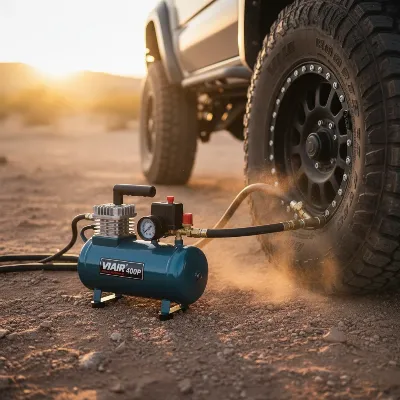 Viair 400P portable air compressor inflating an off-road vehicle tire
Usage and Maintenance Tips for Air Compressors
Proper usage and regular maintenance are not merely recommendations; they are critical practices that extend the lifespan of your air compressor, ensure safe operation, and maintain peak performance. Neglecting these aspects can lead to premature failure, inefficient operation, and potential safety hazards.
Safe Operation Practices
Safety should always be the top priority when operating any air compressor. Compressed air is powerful and can be dangerous if mishandled.
- Read the Manual: Always begin by thoroughly reading the manufacturer’s instruction manual. It contains crucial safety warnings, operational guidelines, and specific maintenance schedules for your particular model.
- Ventilation: Operate the compressor in a well-ventilated area to prevent overheating. Enclosed spaces can cause heat buildup, which is detrimental to the motor and internal components.
- Proper Connections: Ensure all hoses, fittings, and power connections are secure before starting the compressor. Loose connections can lead to air leaks, reduced efficiency, or even accidental disconnection under pressure. For battery-powered units like the Viair 400P, always connect the alligator clamps firmly to the battery terminals, positive to positive, negative to negative.
- Wear Eye Protection: Always wear safety glasses or goggles when operating or maintaining an air compressor to protect your eyes from debris or sudden bursts of air.
- Respect Duty Cycle: For portable compressors, strictly adhere to the recommended duty cycle. Exceeding it will lead to overheating and potential motor damage. For the Viair 400P, remember the 33% duty cycle at 100 PSI—run for 20 minutes, then allow 40 minutes to cool down.
Regular Maintenance for Longevity
Consistent maintenance significantly contributes to the compressor’s durability and efficiency, saving you money on repairs and replacements in the long term.
- Air Filter Inspection and Cleaning: The air filter prevents dust and debris from entering the compressor’s motor. Check the filter regularly (every few uses for portable units, or as specified in the manual) and clean or replace it when it appears dirty. A clogged filter restricts airflow, forcing the motor to work harder and reducing efficiency.
- Drain Moisture: If your compressor has an air tank, drain any accumulated moisture regularly, especially in humid environments. Moisture can lead to corrosion inside the tank and contaminate the air supply. Portable units like the Viair 400P are tankless but still benefit from ensuring the hose is free of significant moisture build-up.
- Check Hoses and Fittings: Periodically inspect hoses for cracks, cuts, or wear, and check all fittings for tightness. Replace damaged components immediately to prevent leaks and maintain system integrity.
- Motor and Component Cleaning: Keep the exterior of the compressor clean, especially around cooling fins and vents, to ensure proper heat dissipation. Avoid using harsh chemicals that could damage the unit.
- Proper Storage: Store your air compressor in a clean, dry environment, away from extreme temperatures and corrosive substances. For portable units, utilize the provided carrying bag to protect it from dust and physical damage during transport and storage.
By adhering to these guidelines, you can ensure your Viair 400P or any other air compressor operates safely, efficiently, and reliably for many years.
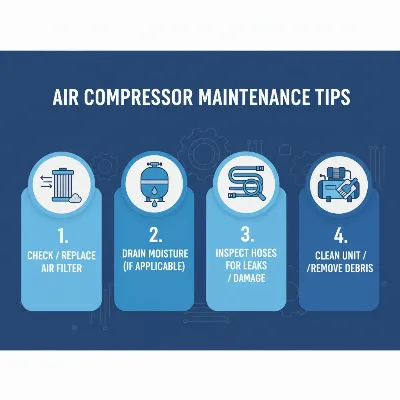 Essential maintenance steps for extending air compressor lifespan
Conclusion
The Viair 400P Portable Air Compressor stands as a testament to robust design and reliable performance in the demanding world of vehicle maintenance and off-roading. Its commitment to quality, evidenced by its sturdy metal construction, efficient motor, and practical features, positions it as a premier choice for those requiring a dependable air solution for their tires. Understanding the nuances of air compressor technology, coupled with a thorough evaluation of your specific needs, will empower you to make an informed decision. By prioritizing proper usage and diligent maintenance, you can ensure that this essential tool remains a faithful companion for countless adventures. What crucial feature do you prioritize most in a portable air compressor for your journeys?
Frequently Asked Questions
What is the primary benefit of the Viair 400P’s metal construction?
The primary benefit of the Viair 400P’s metal construction is enhanced durability and improved heat dissipation. Unlike plastic casings, metal bodies can withstand tougher impacts and dissipate heat more effectively, which is vital for maintaining the motor’s longevity, especially during its 33% duty cycle.
How often should I check the air filter on my Viair 400P?
You should check the air filter on your Viair 400P regularly, ideally every few uses or before a major trip. In dusty or dirty environments, more frequent checks and cleaning may be necessary to ensure optimal performance and prevent debris from entering the compressor.
Can the Viair 400P inflate large truck tires?
Yes, the Viair 400P is specifically designed to inflate large truck and SUV tires, typically up to 35 inches. Its high CFM output and ability to reach 150 PSI allow for efficient and relatively quick inflation, making it a popular choice for off-road enthusiasts and truck owners.
Is the Viair 400P suitable for continuous use?
The Viair 400P has a duty cycle of 33% at 100 PSI, meaning it can run for 20 minutes continuously at 100 PSI and then requires 40 minutes to cool down. While not designed for continuous industrial use, this duty cycle is adequate for inflating multiple large tires in sequence, with proper cooling intervals.
What accessories typically come with the Viair 400P?
The Viair 400P typically comes with a durable carrying bag, a 25-foot air hose with a brass screw-on tire chuck, an inline pressure gauge, and heavy-duty alligator clamps for direct battery connection. It often includes additional inflation tips for sports balls or air mattresses, enhancing its versatility.
